|
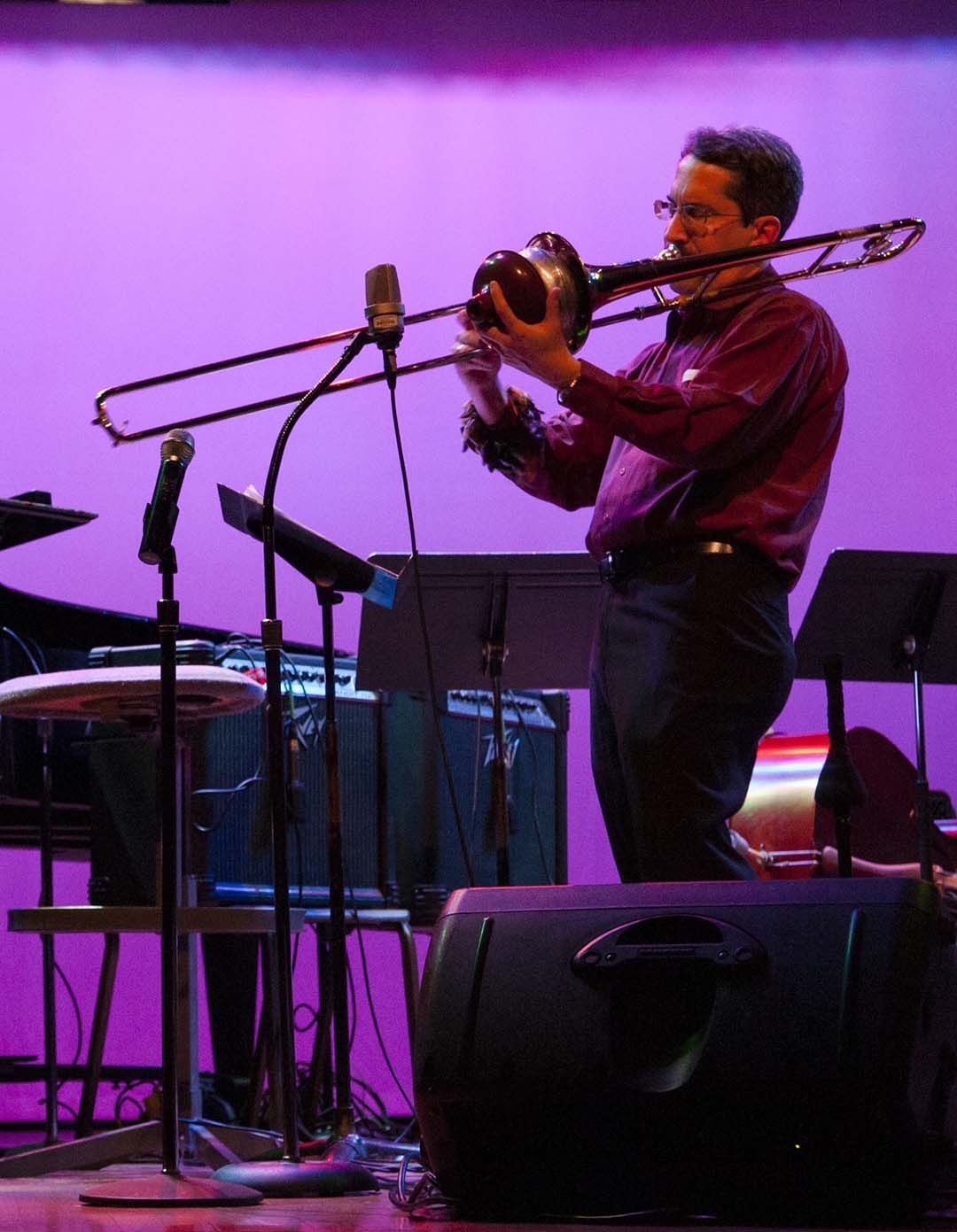
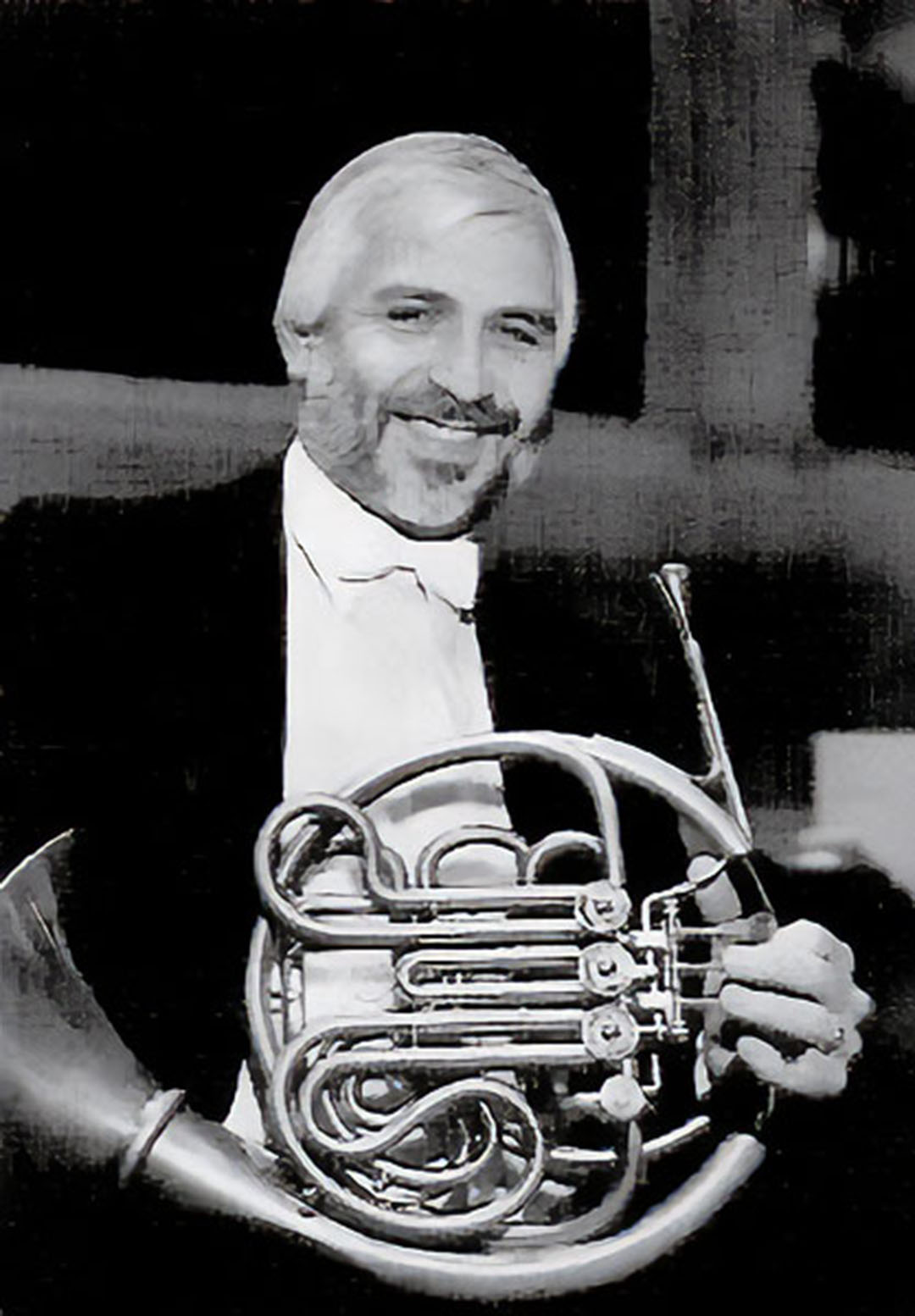
Dale Clevenger.
photo credit:
courtesy
The Instrumentalist |
Revelation I
When I was in college Dale Clevenger, then
principal French Hornist with the Chicago Symphony Orchestra, came to my school,
Loyola University of the South in New Orleans, as a guest artist/clinician. At
one point he, my classical trombone teacher Richard Erb, and my Concert Band
director Joseph Hebert lined up a half-dozen student brass-players, including
me, to breathe in and out of plastic bread-bags in a closed system. Everyone
else’s bag cycled in size—big/small, big/small—while mine got bigger/bigger/bigger,
until full. Clevenger looked at me and exclaimed in his deep Southern drawl, “Sunnnnnn:
wha-yat the HECKKKKK are yooouuuuuu DOOOinnnn’?”
He had me do the exercise again; and he confirmed: “Clearly
you’re not breathing in a closed system.” In my invented word, I was “snore-breathing”
when playing the tenor trombone. I was taking in air the way I did nearly a
third of every day while sleeping, plus a good deal of the daytime, all while
regularly partially congested: I was breathing in through my mouth and my nose at the same time—which can only be accomplished if you raise the back
of your tongue up a bit or tense your soft palette to engage airflow to your
nose.
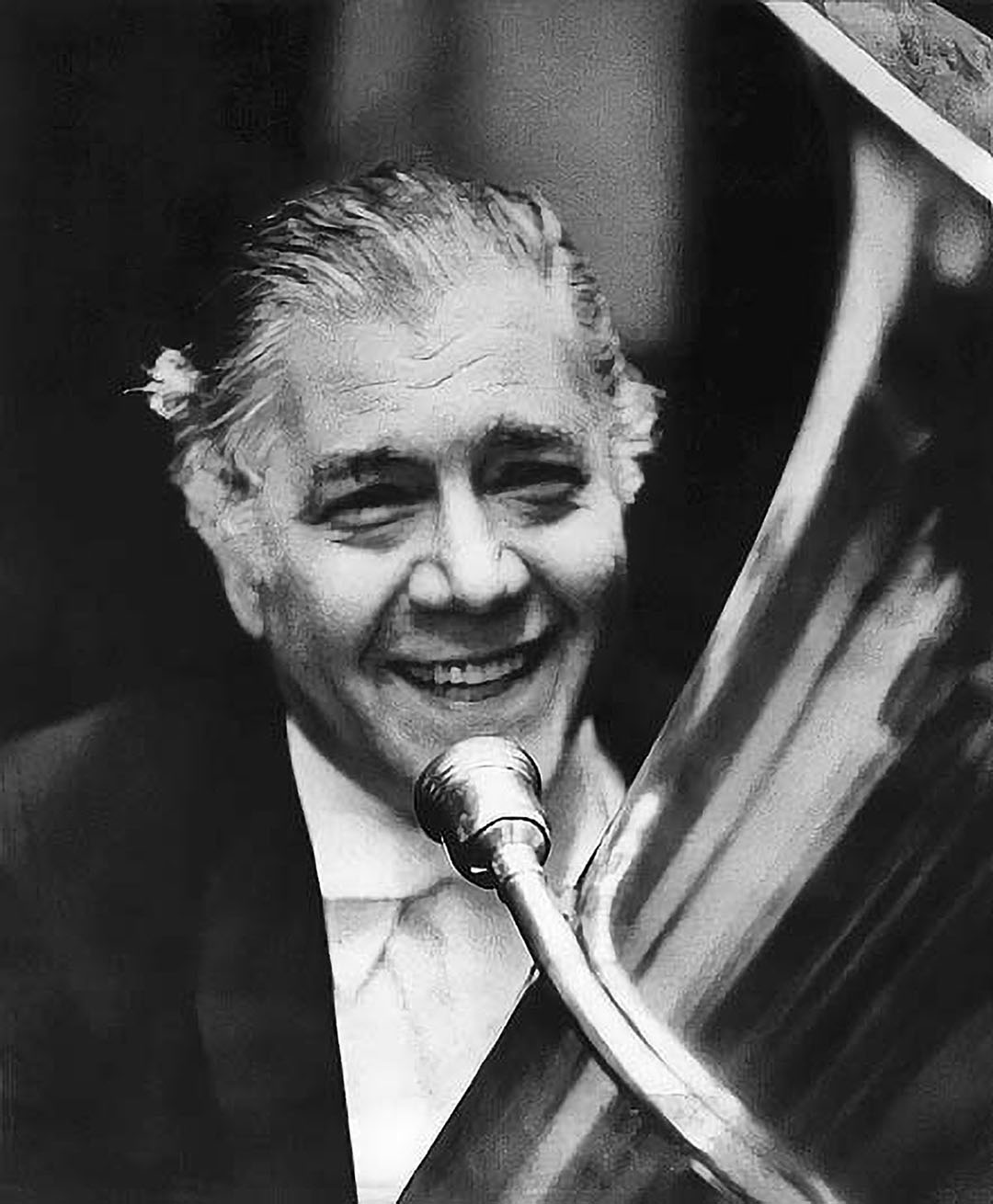
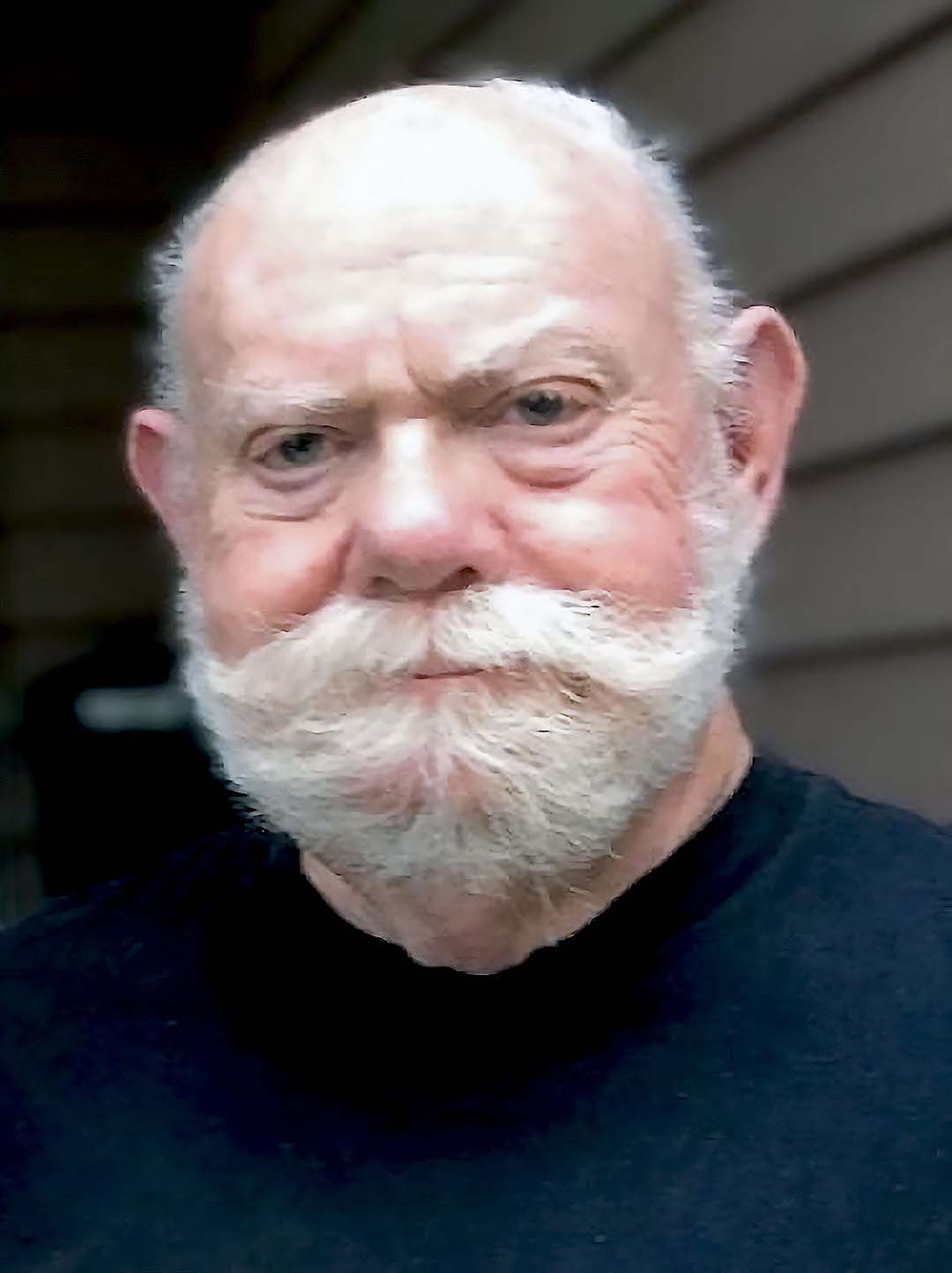
Richard Erb.
photo credit: Michael Grose, courtesy Peter Erb
|
|
That day it took me more than a few minutes of
conscious focus to place my tongue completely down so that I could make the bag
rise and fall like everyone else’s did. It was not easy at first, nor could I
consistently accomplish it. I was shocked, being an almost-20-year-old who
obviously had no idea how to breathe in and out; but that was consistent with
my lifelong history of allergies and asthma: there was no way I would know how others breathe. I was breathing the only “natural” way I knew—which
was unnatural to people who could breathe well.
Clevenger and Erb had both been students of the
legendary CSO tubaist and breathing-guru Arnold Jacobs. Later, in 1980, I went
and took lessons with Jacobs myself, which certainly transformed my musical
life in ways for which Erb had already paved the way.
Erb had told me in one fateful lesson that
year that he didn’t want me to jump out of a window but that I was returning to
each weekly lesson with the same sound-production problems. He felt my studying
even briefly with Jacobs would jumpstart a positive change, and I agreed to
seek lessons with him that Summer. Erb also recommended that prior to my
arrival I mail Jacobs a letter describing my applicable medical history, recent
medical treatment, and possible medically related problems affecting my
music-making. Given Jacobs’ years of formal and informal medical study, he
would immediately understand the context—not that he needed it in order to
improve my playing. The following facts are drawn from that letter.
Medical History
In June of 1980, with a long history of
rhinosinusitis and nasal polyps, I once again underwent examinations from both
an Allergist/Immunologist and an Ear, Nose, and Throat specialist. On the
bright side, my lungs were clear. But a sinus infection was noted, along with a
large number of small, ethmoid polyps. The nasal mucous membranes were
extremely pale, boggy, and approximately 80% blocked. The tympanic membranes (ear
drums) were glistening; and the posterior pharynx (aside the tonsils) was edematous
(swollen with fluid) and injected (congested). Blood tests revealed my IgE (immunoglobulin) level to be 150 (on the higher
end) but my Eosinophil (a white blood cell) count to be 528 (normal
range being 30-350). As has been the case throughout my life, the nurses
tending my series of scratch-tests could not conceal their surprise at viewing my
extreme reactions to all my usual allergens—but it has never been a surprise to
me.
At six months of age I’d
had a severe respiratory tract infection and was on respiratory restrictions
during exercise for three years. I was a highly allergic individual, sensitive
to virtually everything that grew or moved (including being allergic to human
mold!). At the age of 8 I began 18 months of immunotherapy (allergy shots),
resulting in moderate improvement; but over the following decade (overlapping
my starting trombone at age 13) allergic reactions grew; and breathing
worsened. I had moderately severe bronchial asthma until about age 19. A bout
with mononucleosis at age 20 seemed to prompt a relapse into a more severely
allergic state. It was no surprise that cigarette smoke—a staple in the
environment of jazz and nightclubs in which I regularly performed—markedly aggravated
my situation. I often played shows backing such artists as Ella Fitzgerald and
Mel Tormé with a pile of Kleenex concealed in my lap for use during measures of
rest.
|
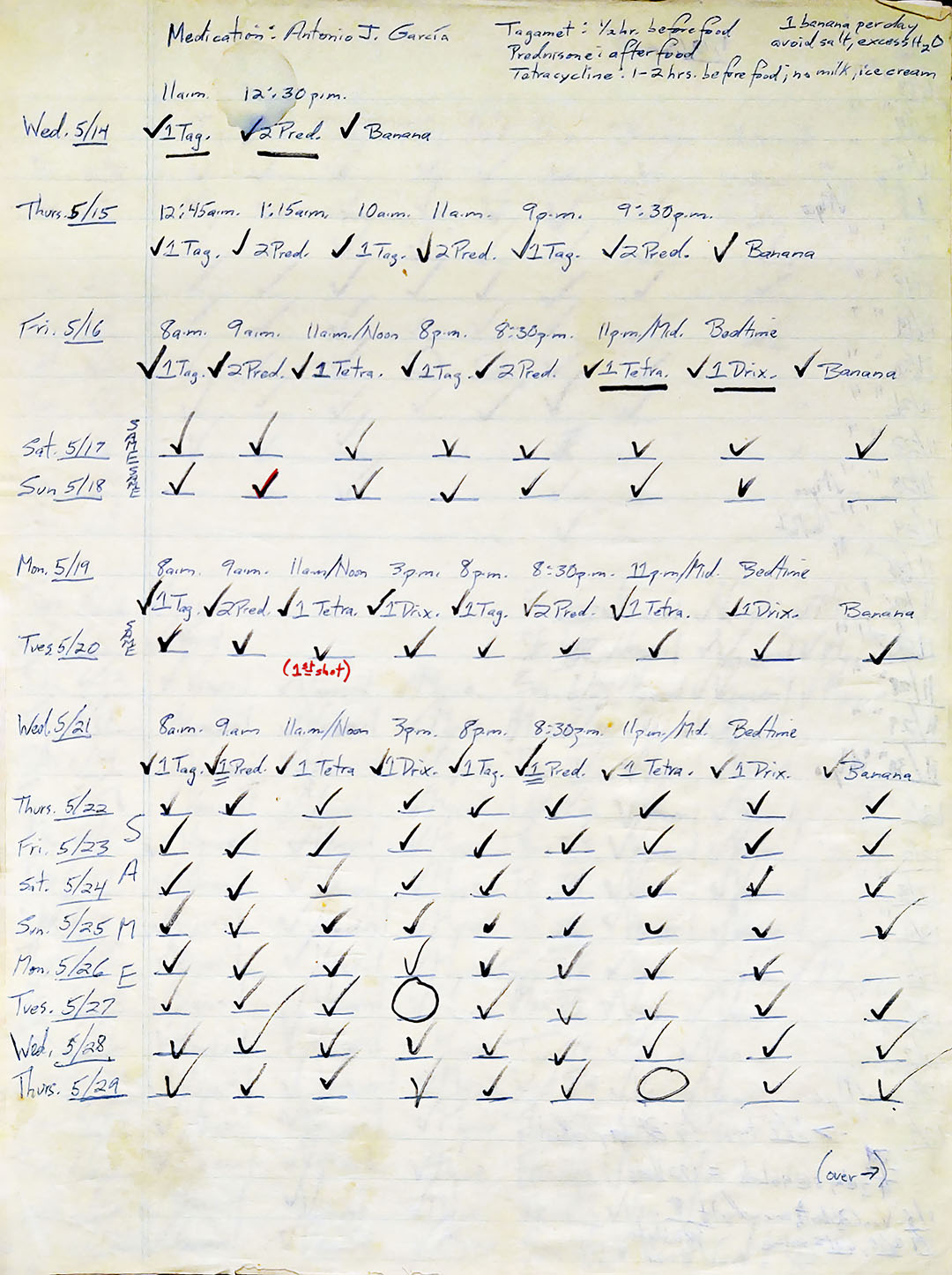
Page 1 of 4 of the author’s May-November 1980 dosage log.
photo credit: courtesy Antonio García |
Medical Interventions
Surrounding the above
examinations I underwent the following treatments to shrink swelling and lower other
allergic reactions:
· Over the span of May
14-June 8, 1980: 60 Prednisone (steroid) tablets, 40 Drixoral (dexbrompheniramine and pseudoephedrine) tablets, 30
Tetracyclin (antibiotic) capsules, and 46 Tagumet tablets (to mitigate the
stomach-issues caused by the other medications).
· Over the course of June
10-July 20, 1980: 2 Afrinol tablets (discontinued because the pseudoephedrine had
aggravated the worsening problem of a racing pulse), 85 blasts of Vanceril (topical
nasal Beclomethasone steroid) in each nostril, and at least 22 oral treatments
with a Mycostatin suspension (to mitigate the potential of fungus stemming from
the antibiotics’ killing of friendly bacteria in my mouth and digestive
system).
· Ongoing use of Vanceril,
Mycostatin, and an outlined program of immunotherapy shots (approximately a
dozen by the Chicago trip).
My doctors reported
that due to the above treatments my nose had improved from 10% efficiency to
70%. However, this increase had not been accompanied by any noticeable
improvement in my trombone-playing. In addition, the pseudoephedrine prompted many occasions when my pulse
was 120 sitting at rest. Initiating trombone-playing would often spike my pulse
into the 160s or higher. If I were home and opted to set the trombone down and
rest for a few minutes, I’d often wake up an hour or more later, exhausted.
These conditions lasted for months past my last consumption of the medicine; so
I learned and employed numerous mindful techniques to regulate my pulse so that
I could not only play trombone but live productively during that time.
Musical Challenges
When playing trombone I’d encountered the
following situations regularly:
· Inconsistency of
sound production (attack and tone).
· Lack of breath
control, air movement (including the Valsalva Maneuver).
· Tendency to contract stomach and raise diaphragm while inhaling.
· Inability to
circular breathe.
· Insensitivity of the
lips, with periodic edema (swelling).
· Lack of flexibility,
inability to trill.
· Inability to
consistently tongue in a marcato style in any range, particularly at louder
volumes.
· Constriction of and
vocalization in the throat, particularly when tonguing.
· Inability to cleanly
attack (even singularly) any note in the range above F1, despite a legato range
often exceeding F2.
· Occasional
uncontrollable “octave-doubling” while playing.
· Preoccupation with
biological feedback (“how it feels”) over musical feedback (“how it sounds”).
· Inability to “teach
myself,” to eliminate problems that recurred after previously having been
solved.
You may have surmised by now that I was
by no means a “natural” player of the instrument. And by the age of 21,
entering my senior year at Loyola University of the South in New Orleans (where
I majored in Jazz Studies), and after eight years of playing trombone, I could
see that any technical improvements had slowed to a stop. The previous year in
particular had seen few advancements in my playing style, those advancements
owed to a gradually better knowledge of general musicianship. I could find
little satisfaction in the classical music medium (in which I wanted to
participate) and encountered continual obstacles to jazz-playing as well. That
said, I was gigging constantly in my native New Orleans, performing 15-30
engagements a month primarily playing written music in jazz, pop, and classical
genres while doing everything I could imagine to circumvent the issues noted
above.
Knowing that Jacobs
expected me to call him once I’d arrived in Chicago to then arrange my
lesson-times with him, I planned a trip there for four nights and three days. I
was eager to get whatever time with him I could. My accommodations at the
Pick-Congress Hotel were just down the block from his studio at the Fine Arts
Building, Room 428, 410 South Michigan. I shipped my tenor trombone from New
Orleans via Federal Express in considerable packing materials rather than leave
it to the airline of the day. I had just turned 21, and this was my first
plane-flight.
I am an aggressive
note-taker and still have my assignments handy from every undergraduate and
graduate trombone lesson I’ve taken. My mindset was no different during my
lessons with Jacobs; and though I did not write constantly during those
lessons, I exited the studio only as far as to sit down on the bench outside
his Room 428, where I wrote for as much as an hour following. While sitting
there I met others of his other occasional students, including a bassoonist
from the Bavarian State Opera (Munich, Germany). It was clear confirmation that
Jacobs’ advice was sought across any instrumental or geographic boundaries.
Visit 1, Lesson 1: Wednesday, August 6, 1980, 2-3p.m.
Jacobs asked me what instruments I played (trombone,
some piano) and what my academic concentration was (jazz). He then invited me
to play anything for him; so I played the melody to “Polka Dots and Moonbeams” (Ex.A) at a suppressed volume, including some notes that wouldn’t speak.

|
Ex. A: Polka Dots and Moonbeams.
© 1939 Bourne Co., My Dad's Songs Inc., Marke Music Publishing Co. Inc., Pocketful of Dreams Music Publisher, and Reaganesque Music Co. |
He then asked
me to perform some classical; so I played Pichareau #1 (Ex.B),
still with some hesitation in the notes.

|
Ex. B: Pichareau 21 Etudes for Trombone, #1.
© 1960 Alphonse Leduc |
He invited me to play some extremely
familiar material; so I delivered Rochut #2 (Ex.C), with much
silence between notes.

|
Ex. C: Rochut Melodious Etudes for Trombone, #2.
©1928 Carl Fischer Inc. |
With my permission, he then
took my trombone and played it with a far better sound than I had. He explained
the conceptual difference between “pressured” air (wind locked inside the body)
and “thick” air (wind moving outside the body), offering that my air was suppressed
inside my body and that the little air that was moving was being interrupted by
the movement of my tongue and by abdominal isometrics.
Jacobs then brought out
a spirometer: an instrument gauge with a tube-attached funnel, measuring not
wind-flow power but wind-flow steadiness. My airstream barely moved the meter;
yet when he blew into it, his air swung the readings fully across the scale. He
said I should visualize the air separating the pages of the music in front of
me, thus thinking of air moving outside the body, not concerning myself
about proper internal (i.e. lung) movement and the like.
The steadiness of my
airstream then immediately improved vastly.
Jacobs offered that I had
a relatively small lung capacity (perhaps approximately 4 liters); so I must
use all my capacity to keep up with players having 6 or more liters. He
said I must try to forget about “feel” (physical feedback). Instead, concentrate
on pre-hearing my desired sound in my head, not worrying about the
actual results as much, and thinking not at all about proper internal function:
function must be a natural act.
To demonstrate, without
warning he threw a pencil at me, which I caught. Jacobs said that proper
breathing would be the result of the same unconscious response to stimuli. So
concentrate on pre-hearing: that artistic input in his estimation was
85% of the requirement. The other 15%, the physical motor movement, requires
only the simplicity of a 5-year-old catching a ball.
My sound was then much
improved.
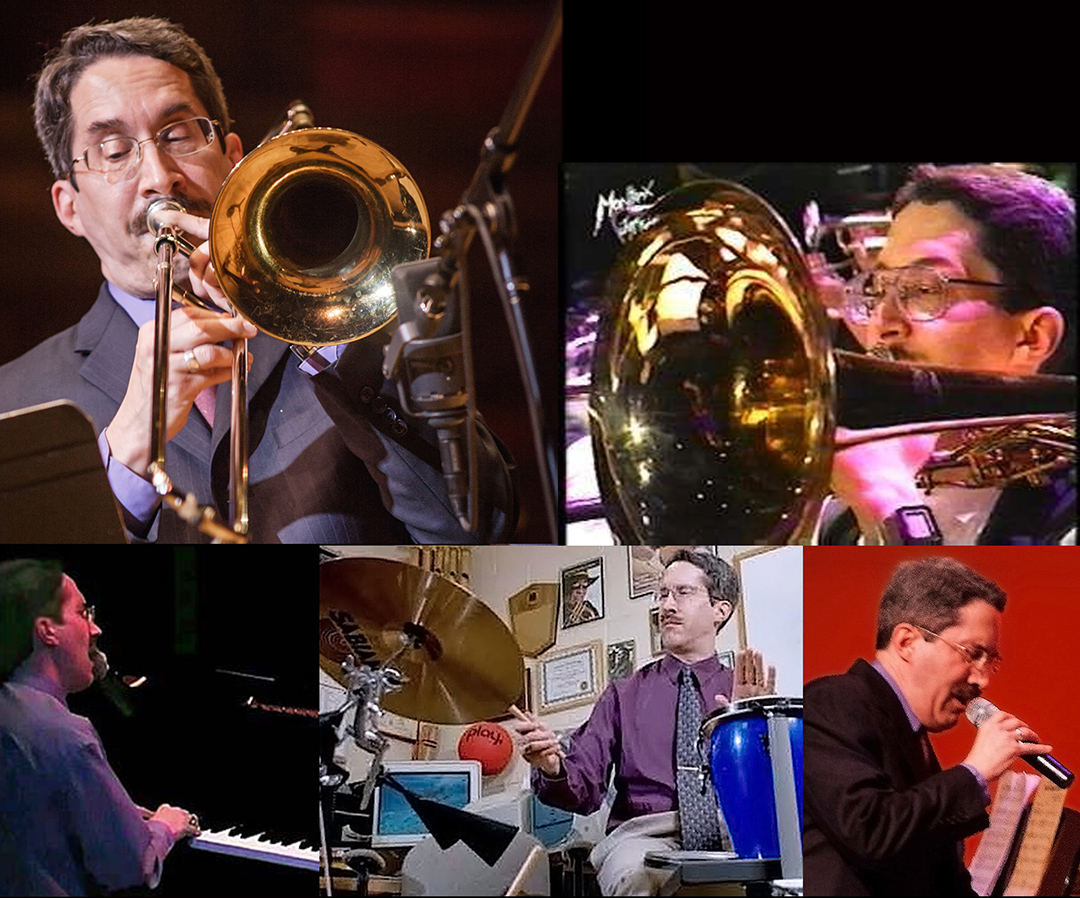
The author in vocal and instrumental settings.
photo credit: courtesy Antonio García
|
|
Jacobs then brought out
an incentive spirometer: an instrument with two ball-gauges (one for inhaling, one
for exhaling) attached to hoses leading to one mouthpiece. He asked me to buzz
a mid-range note at an intensity necessary to maintain exhalation at a certain
rate. He then removed the mouthpiece and asked me to inhale and exhale (with
steadiness, not power) into the hose so as to move the balls consistently up to
certain level. When I was doing this regularly, he asked me to glance into the
mirror at the result: proper chest-movement created by proper windflow. (Both
Jacobs and Erb encouraged use of the word “wind,” which suggests movement,
rather than “air,” which may suggest a static presence.)
He instructed that I
must visualize the images of the ball-scale and steadiness-meter while playing
so as to improve more quickly. This visualization during performance appeals to
the memory of an additional sense other than hearing: sight, thus
reinforcing my intent to my brain. The brain, subconsciously knowing
much more about my functions (and disabilities) than I do consciously, will direct
my body as it needs to in order to duplicate the sound I’ve pre-heard.
Jacobs invited me to
read Rochut #2 again. He stopped me after a few bars, picked up a book, and
began reading in a monotone, explaining that’s how one reads for information. Then
he began reading as if delivering a speech, explaining that’s how one
communicates to someone else. He said we make the same difference while
performing music: never allowing oneself to read for information, even
during practice. His reason anatomically is that the fifth and seventh
cranial nerves are attached to the embouchure. The fifth receives physical
feedback (i.e., a sensor nerve for “learning”); the seventh is a motor nerve
that, given proper stimuli, operates the lips for “presentation.” We must be
sure that attention is given to presentation at all times.
I must state here that
prior to this lesson I had often wondered as to how it was possible that I
could have occasions when my embouchure had felt terrible while I played
markedly well, as well as occasions when my embouchure had felt great while I
played poorly. Every brass-player I’ve ever discussed this with has experienced
the same. And the reason, simply put, is that the nerve that tells the brain
how our “chops” feel is completely different from the nerve from the brain that
operates those “chops.” So if our mental focus is correctly aimed at
pre-hearing our sound, it is possible to override poor physical
sensations with a directed mental image. And conversely, if our mental focus is
poor, a great embouchure and windflow may not result in a fine performance.
I then played Rochut #2
with improvement.
He suggested that I work
on smaller phrases with proper sound now, saving more lengthy phrases for
later. He emphasized that I must not be subjective while playing: I cannot
analyze and play simultaneously. I must be objective: perform!
He then asked me to play
some jazz, requesting the “When The Saints Go Marching In” melody. My rendition
ignored the word “the” and loudly hit “Saints.” When requested to sing it, I
surprisingly sung it the same way. So he asked me to play the melody again,
emphasizing the note for “the.” I was unsuccessful. But when he then asked me
to pre-hear what that new version should sound like, I delivered the
phrase successfully.
He asked me to play the
Arban scales on (my edition) p.63, #1 (Ex.D).

|
Ex. D: Arban’s Famous Method for Slide and Valve Trombone, p.63, #1.
©1936 Carl Fischer Inc. |
My playing
emphasized some notes over others. But when he then asked me to pre-hear a
smooth version, it worked: I delivered evenly phrased scales.
He then stated
something I’d heard from Richard Erb many times before. When exploring new
phrasing, the physical feedback I received would different than before. But “different”
didn’t mean “wrong” any more than “familiar” meant “right.” (As I have often since
stated to my own students, my two criteria for assessing a new result are: “does
this version suit the genre better?” and “is anyone hurt?” If it sounds better
and there’s no apparent injury to one’s embouchure or nearby musicians’ ears,
you’re probably onto a good thing!)
Jacobs said that I must
expect, though, that some skills would be weaker when playing in this “new” style until I’d worked on them sufficiently. He suggested
that I buzz jazz melodies on the mouthpiece—nothing slow enough to self-analyze,
just performing on the mouthpiece—for at least a half hour per day.
(Doing so on my bass trombone mouthpiece in later years also had a profoundly
positive effect unlocking a melodious style on that instrument.)
He closed the lesson
saying that we must meet again to work on the movement of my breathing (so as to
lose abdominal tenseness) and use of my lung capacity.
Visit 1, Lesson 2: Friday, August 8, 1980, 11a.m.-Noon
|
 |
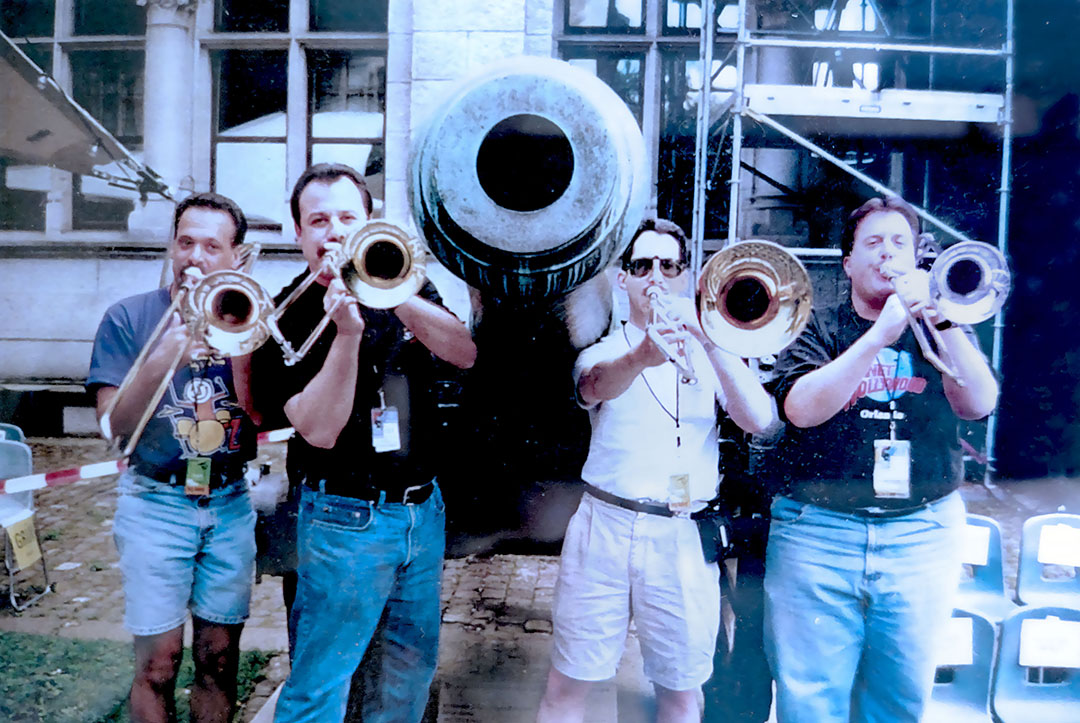
"Four Cannons and a Relic": The Phil Collins Big Band trombone section pre-concert at the Zürich Landesmuseum, 1998. Mark Bettcher, Arturo Velasco, Antonio García (bass trombone), and Scott Bliege.
photo credit:
courtesy Antonio García |
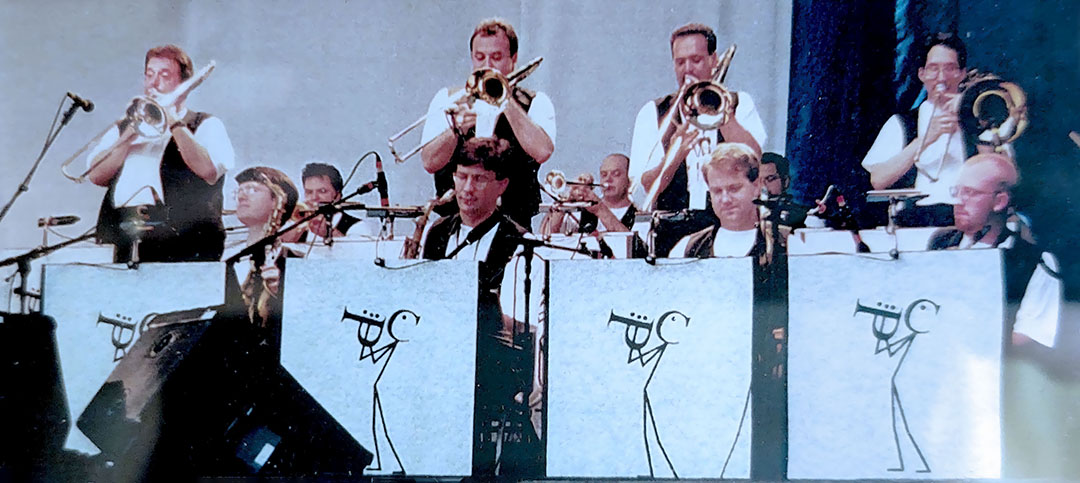
The Phil Collins Big Band trombone section: Scott Bliege, Arturo Velasco,
Mark Bettcher, and Antonio García (bass trombone), 1998.
photo credit:
courtesy Antonio García |
After I briefly warmed up, Jacobs emphasized that
I must give each note equal importance, must picture the sound in my head. He again
brought out the incentive spirometer (with two ball-gauges, one for inhaling,
one for exhaling) and asked me to make the two levels match while breathing. He
stated again that my pulmonary function was fine but that I must use it fully. After
I played some scales, he again emphasized equal importance to all notes.
Jacobs explained that I
should visualize breathing in and out of my mouth, not out of my lungs
or body, because otherwise my muscles would move in a fake manner mimicking air
intake while actually not filling my lungs to capacity. He asked me to move my
stomach to enlarged and shrunken positions without breathing so as to
notice this “black and white movement” of the expanded and emaciated stomach walls.
He then suggested that I think of breathing not
as horizontal expansion and contraction but instead as vertical, like a piston.
About half the air supply involves lowering the diaphragm; if that instead raises
during intake, considerable air is lost. And yet, he said, I could not specifically
order my diaphragm to move, any more than I could order my spleen to do so: my
diaphragm would move when air moved properly in and out of my mouth, thus
expanding and contracting the lungs above the diaphragm.
My decibel level was generally
too quiet; my expectation of what was coming out of the bell didn’t match the
decibel meter’s assessment. He told me that I should practice with a strong,
soloistic forte so that there’s room to crescendo and decrescendo, and with
equal importance to each note.
Jacobs stated that our
lungs have the capacity to hold so many ounces of air, but our abdominal muscles
have capacity to exert 10 or 12 pounds of isometric force when used in
opposition to each other. So we must weaken all our muscles in the abdominal
area when playing so that there’s room to be flexible with our air and sound.
He stated that “strength is your enemy; flabbiness is your friend.”
He suggested I over-breathe
(breathe “too often”). Have air to waste: don’t get caught playing while in the
downward end of the respiratory curve. If need be, shorten phrases in favor of maintaining
a soloistic sound; length will come later.
Jacobs informed me that
the reason why my stomach wall wouldn’t expand during inhalation was because I
had never contracted it during exhalation! So he emphasized that I must, for a
while, give conscious attention to my abdominal movement in order to create new
stimuli. Eventually new, natural stimuli would take over the function without
my conscious attention.
He asked me to play long
tones: Arban p.17, #1 (Ex.E).

|
Ex. E: Arban’s Famous Method for Slide and Valve Trombone, p.17, #1.
©1936 Carl Fischer Inc. |
Practice giving full attention to picturing
the sound and (for a while) to proper abdominal movement. Play jazz ballads at
strong volumes.
His summary to me was
that simplicity, in general, is the key for solving most physical problems.
Given the proper musical picture, the brain will command the proper motor-work
(i.e., catching the pencil). Brass-players, unlike woodwind-players, have “flesh
and blood reeds.” By playing at consistently louder volumes, the lips will
learn to respond; otherwise, they can lock off air just as abdominal tension
and tongue-placement had for me before this day.
Most importantly, give
attention to the “art” over the motor-mechanics.
Interlude
The improvements to my playing were immediate,
profound, and in majority lasting. Also important was the feeling of relief that overcame me after even the first lesson: relief that endless performance-problems
seemingly out of my control were now becoming matters I could control. I
had a future. By no means had I become a virtuoso player, but I had received
stimuli and direction from Jacobs that supercharged the perspectives already
given me by Erb and more. In the months following, I was actually improving in
lessons and on my own and enjoyed a senior year less fraught with negativity
surrounding the trombone. I was focusing on pre-hearing my sound and far less
so on the mechanics of trombone-playing.
|
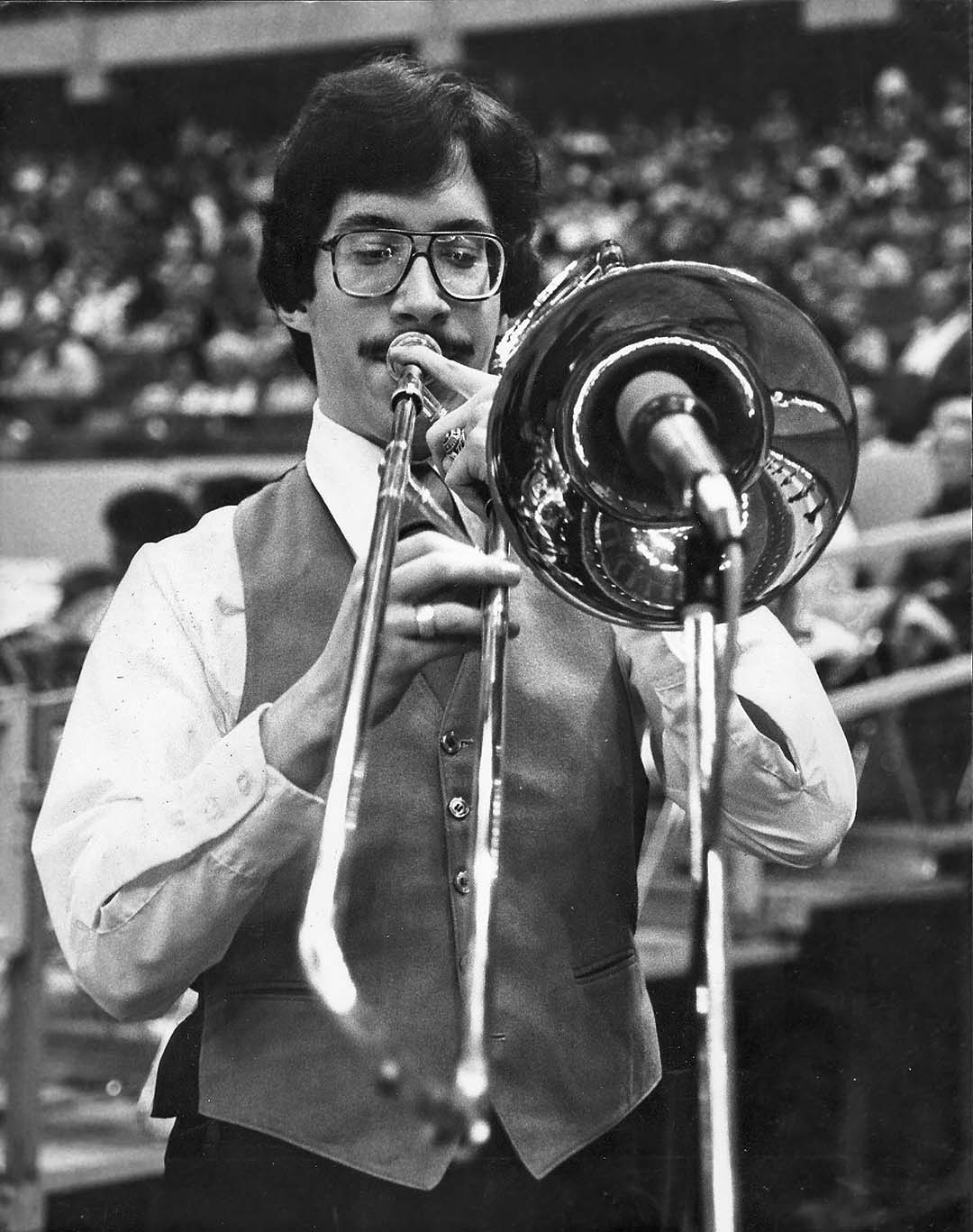
García as tenor trombonist of the New Orleans Saints Combo, circa 1980, a recurring job he received from Dr. Joseph Hebert, providing experience in front of 70,000 attendees each game.
photo credit:
José L. García II |
Prior to my lessons
with Jacobs, I had actually been doing isometric abdominal exercises as a
workout. But given his assessment that I had been exerting those muscles unnecessarily
while playing, to my airstream’s detriment, I gave up those exercises
immediately. Perhaps I could have learned to relax my abdomen during
performance while continuing my workout-regimen, but I decided I needed every
bit of momentum on my airstream’s side while proceeding to learn how to focus
on pre-hearing my best sound of the music before me. I was also aware that
others’ pedagogical approaches actually favored using isometric tension as a
breathing tool, but I was not interested in exploring an aspect of abdominal
tension so closely related to my previous difficulties.
I’d listed the Valsalva
Maneuver as one of my musical challenges. You can find plenty of information
online regarding this tense way of breathing, including statements from Richard
Erb within his article/book-chapter listed below. As a form of bearing down
while breathing, it requires a closed glottis so is utterly contradictory to
good windflow. My first lesson with Jacobs freed me from my subconscious use of
the Valsalva Maneuver, yet he had never mentioned the topic. It was simply
impossible for me to employ that tense tactic while pre-hearing the desired
music and visualizing my airstream moving vertically through my torso and out
my mouth at the pages of music I sought to move. Such a change emphasized to me
the pedagogical concept shown me by both Erb and Jacobs: saying “no” to a bad
habit is rarely effective; but it is often easy to introduce a new, more
desirable habit to overwrite the old one. Erb would at times overwrite my
body’s tension by placing me in his office chair and requesting that I play
Rochut #2 or similar while he gently wheeled me back and forth and around the
space. I had to let go of the rigidity of my body in order not to fall out of
the chair, resulting in better tone and attacks that I could then recapture
while standing.
I should mention that
Jacobs’ pedagogical manner was unimposing. He immediately conveyed a welcoming
attitude, as if I were an invited guest to his home. He offered his
instructions as the suggestions of a mentor I’d requested join me, not
posturing himself as an acclaimed god whose every word should be inscribed on a
granite wall. I thought of him in a grandfatherly way—a grandfather with
tremendous knowledge—and if Richard Erb were a mentoring trombone-father to me,
then that analogy regarding Jacobs was appropriate.
I definitely felt our relationship was
founded on two-way respect: I of course entered the room seeking his pending
perspectives during my lesson; but my feeling was that he also respected that
I’d invited his insights. Not every student senses that coming from a teacher
during lesson one, but I was fortunate to receive that from each of my formal
trombone and jazz mentors.
After graduating with
my B.M. in Jazz Studies in May 1981, I decided in the Fall of that year to
audition for graduate school the following Spring for potential entry Fall
1982. My chosen destination was The Eastman School of Music, whose jazz and
classical recordings I had heard and where many of my professors had attended.
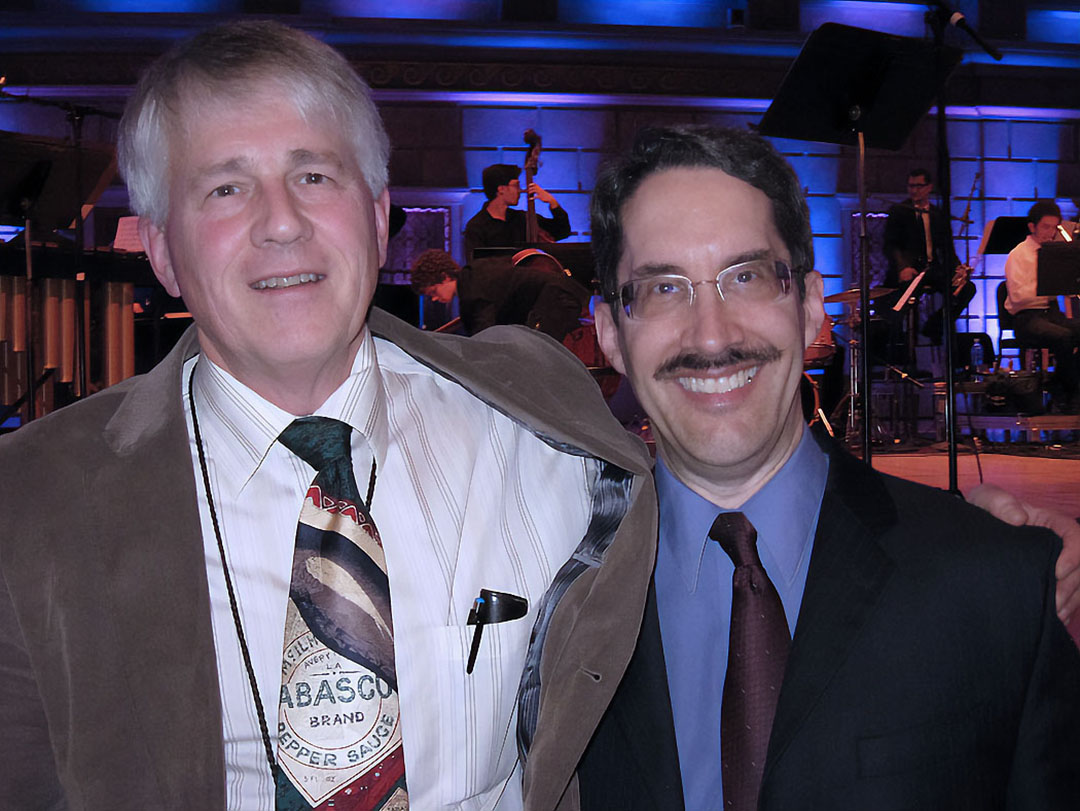
John Mahoney (left) with Garcia at a Ray Wright Tribute concert, Eastman School of Music, October 2012.
photo credit: courtesy Dorien Mahoney
|
|
My jazz trombone and arranging teacher, Prof. John Mahoney
(an Eastman alumnus), advised me that he could not yet recommend me for
graduate jazz performance but suggested I showed promise towards entry into a
graduate jazz writing degree. Towards that end, I began assembling my writing
portfolio and practicing my trombone towards that goal while continuing to gig
heavily in New Orleans. His advice would soon change my life for the better.
Meantime, one airline was
offering an option for multi-city routing at a very low price; so I scheduled
an itinerary for February 1982 that began with in Rochester, NY for my Eastman
audition, then took me to Giardinelli’s in New York (where I purchased my bass
trombone) and Chicago (to study again with Jacobs) before returning to New
Orleans. I was fortunate to receive one more lesson from Arnold Jacobs.
I was not fortunate in that the trunk
in which I’d transported my horn was lost on the shuttle van ride from the
Chicago airport to my hotel. After calling all the preceding hotels on the
shuttle route, I had to file a police report and then contact Jacobs for a referral
to a local music store. It was so kind to rent me a wonderful trombone for a
few days at such a low cost that could only have been due to the value of a
referral from Arnold Jacobs. I also had to venture out in the snowy city to buy
a couple of sets of winter clothes for my stay, as mine were in the trunk!
Visit 2, Sole Lesson: Tuesday, February 9, 1982, 5-6 p.m.
I began with a few warm-up notes, then played
Rochut #1 (Ex.F).

|
Ex. F: Rochut Melodious Etudes for Trombone, #1.
©1928 Carl Fischer Inc. |
Jacobs assessed that while the tone was
acceptable, the dynamic was too soft. He suggested that I should play more in
the middle of the dynamic range, as I tend to remain too quiet. (I have since
adopted for my own students Richard Erb’s metaphor for “soft” as the feeling of
soft fabric with your fingers.)
I played the opening of
Rochut #2 with a poor attack on the initial note. He reminded me to pre-hear
the sound and said that if I wished, I could think of a spoken word for the
note, such as “one.” Play firmly, soloistically, always performing for others,
never just for myself. Think sound: my sonic concept will then travel
from my brain via the seventh cranial nerve to my lips.
Ignore any fifth-cranial-nerve
sensory feedback from my lips back to my brain. If there’s a sound-production
problem or if my embouchure “feels bad,” concentrate more on the sound-concept
in my head: that’s most of the music-making.
Jacobs cautioned me not
to mistake abdominal movement (body shape) for air intake. Always visualize
taking in my full air capacity through my mouth rather than into my
chest; the mouth is key. Take in full air capacity; breathe often; waste air;
overplay dynamics; and keep phrases short enough to accomplish those goals.
Once those are done with a good sound, then target longer phrases—but don’t
lengthen mediocrity.
He opened Arban to
p.46, #10 (Ex.G) and #11 (Ex.H), half-note
long-tones with crescendos.

|
Ex. G: Arban’s Famous Method for
Slide and Valve Trombone, p.46, #10.
©1936 Carl Fischer Inc. |

|
Ex. H: Arban’s Famous Method for
Slide and Valve Trombone, p.46, #11.
©1936 Carl Fischer Inc. |
He directed me to ignore the written crescendos and
instead play the notes fully, but never forced. I then played Arban #12 (Ex.I),
half note to quarter, with the written crescendo, then repeating with an
unwritten decrescendo requested. Always pre-hear the initial attack’s sound.
Never force the sound; but always move air, creating a constant increase or
decrease of sound via wind-speed. I then did the same with #15.

|
Ex. I: Arban’s Famous Method for
Slide and Valve Trombone, p.46, #12.
©1936 Carl Fischer Inc. |
He then directed me to
Arban p.101, #24, bottom score (Ex.J) and asked me to play it in
a slow 8/8 (rather than the marked brisk 4/4), firmly and with vibrato.

|
Ex. J: Arban’s Famous Method for Slide and Valve Trombone, p.101, #24, bottom stave (but in slow 8/8).
©1936 Carl Fischer Inc. |
He requested
I employ slide vibrato (rather than lip or jaw or breath vibrato)
because, as a “medicinal tool,” it tends to center the pitch by finding the
best point of the slide at which to vibrate the desired pitch. (I have since found
that my own students have often benefited from this approach.) He also
emphasized singing “bel canto style” (sustained breath, expressive sound) as a
model for the horn.
Always visualize the
air from the bell moving the pages. I was still utilizing too many air-intake
muscles during expiration of my breath, resulting in isometric tension in the
abdomen. Just blow!
Certainly the above
notes show that I’d not solved all my playing-concerns by this third lesson,
but less of his efforts were required this visit to nudge me back on track.
Happily, I received word before my departure
from Chicago that my trunk (and horn within) had been found in another Chicago
hotel and would arrive back at the New Orleans airport a few hours before I,
ready for my pickup to take home. Apparently, despite all protests to the
contrary from the shuttle driver, he had indeed unloaded my trunk at the wrong
hotel stop, where it had spent several days unnoticed in a hotel room closet
before someone took action regarding the poster-sized contact information I’d
plastered on both sides of the trunk before the trip!
Revelation II
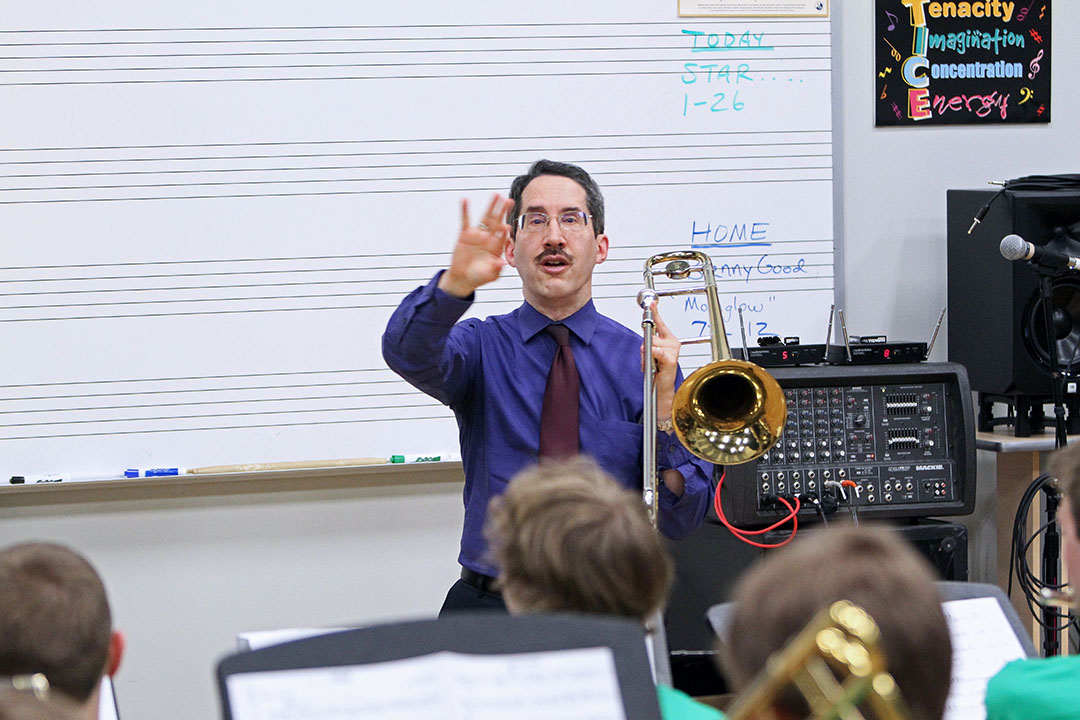
García coaches a high school jazz band rehearsal.
photo credit: courtesy Trinity Episcopal School
|
|
Not long after that time, still approaching my
mid-20s, I often played extended theatre-runs in the pit and realized that
after a show I’d have considerable gas in my stomach, despite only having drunk
water and eaten nothing just prior. It was a regular occurrence. And to my own
interest, the gas was not aromatic; so it didn’t seem to have anything to do
with whatever I had eaten earlier that day.
Finally realizing that my entire life I’d had in my
home an actual brain surgeon with a thoracic specialty—my dad—I asked him if he
had any ideas about this. “Absolutely,” he said. He showed me that the sheer
volume and velocity of a brass-player’s “wind” often creates more windflow than
the human valves engaging nose and mouth are built to handle. (We “brassers”
are special.) So in a healthy-breathing brass-player, the excess wind within
the oral cavity must escape through the “relief valve” of the nose via the
partially relaxed soft palate. (For medical illustrations and further details,
read our co-written article “So Why Do I Need My Nose To Breathe Through My
Mouth?.")
But what if you’re not “normal”? What if you’re a
bit congested? Then that “relief valve” is not available to accept the excess
wind and let it escape through your nose. Instead that excess air, he revealed,
is forced to go the only place it can go: down your throat into your stomach (because your nearby windpipe is already busy moving air upwards). So
the more I’d play brass while congested, especially loud passages, the more I’d
send a decent fraction of outgoing air backwards, into my stomach,
resulting in gas that had nothing to do with my meals.
Postlude
|
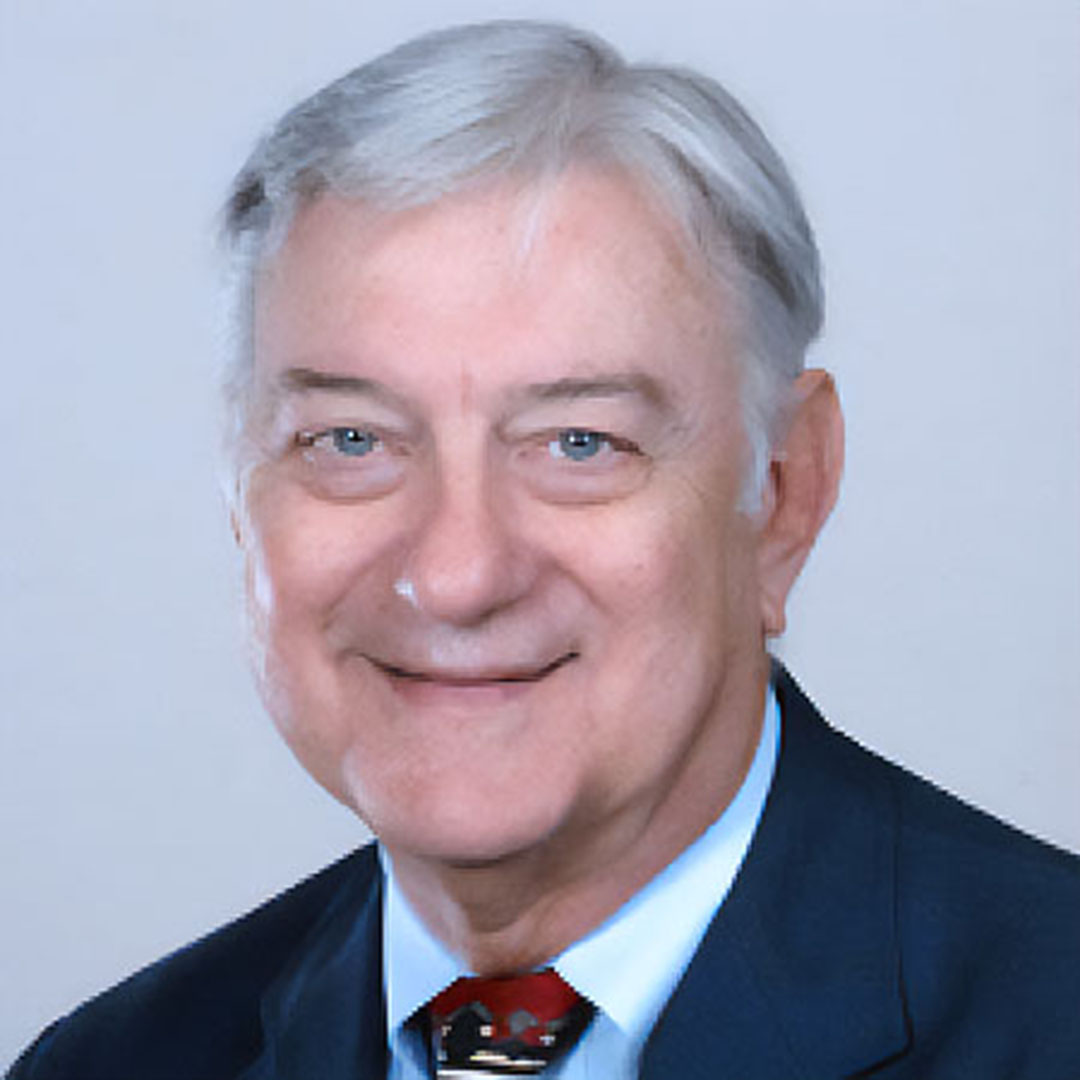
Dr. Joseph Hebert.
photo credit:
courtesy Loyola University New Orleans |
In August 1983 I entered the Eastman School
of Music as a jazz writing major, with bass trombone as my major instrument,
playing that and tenor trombone in various ensembles. If you’ve done the math
from my February 1982 trip above, you’ve realized that my first application to
Eastman had not been successful. But the night of receiving the rejection
letter, I had a gig in New Orleans with a great pop band that included my
Loyola Concert Band director, Dr. Joseph Hebert, on bass.
On a break between sets, I told him about the
letter. He offered: “How about you come back to Loyola for a year—free
tuition—and study yet more trombone, jazz trombone, and jazz composition?
Anything you write for our ensembles, we’ll read; and if it’s good enough, we’ll
perform it. In return, play tenor and bass trombone as needed in our ensembles.”
I quickly agreed; and his offer launched me into a new level of learning
opportunities (coupled with my ongoing gigging in town).
Getting into Eastman on my second attempt
brought me the Eastman Trombone Choir, New Jazz Ensemble, and Jazz Ensemble, additional
incredible peers and mentors, and especially the extended opportunity to
understand writing music as a means to process how to perform it. I could rather easily control and pre-hear articulation, dynamics, pacing, and more in
my composing: transferring that affinity to my playing seemed to make
greater sense to me than ever before. And on a concert on November 21, 1983, I
played my first decent, fully improvised jazz trombone solo—at 24 years old,
after a decade or so of trying. I am indeed, as I tell my students, the
poster-child for late development in jazz as well as in brass-playing—a long
road which I have since found provides me significant strengths as a teacher.
As meticulous as my
notes from my lessons with Arnold Jacobs were, I have no record of what I paid him
for my three lessons. Was it $100/hour in the 1980s? More? Clearly I did not
care, as the lessons were priceless.
In preparing this
article, reviewing my original notes for the first time in decades, I was
struck by how today I still employ every element of my lessons with
Jacobs. I have never found a single contradiction or even an unused portion of
his advice: his mentoring is manifested in my daily approach to the trombone.
And as a composer, of course, the importance of pre-hearing the sound I wish to
create on the page is indispensable towards then creating the best notation
possible for the musicians who will perform it.
The Proof Is In The (Re-)Doing
There’s no question
that part of the positive impact of studying with Jacobs was that he was
Arnold Jacobs. He was the breathing guru. He was not in my
city. I had to journey to him on my first plane ride. Erb had already taught
me the glue of Pavlovian “cue, response, reward”: sitting in the same chair in
the same room with the same teacher week after week may cue a student to repeat
previous issues rather than move forward. He knew that if nothing else, the
newness of my visit to Jacobs would probably shake me loose from perpetuating
problems and provide me a new avenue forward. But Jacobs’ impact was far more
than that, and I later found myself repeatedly in a better position than most
to prove so in a very scientific manner.
I may have become a
better trombonist by the mid-eighties, but I was no better a breathing human.
My nose and sinuses constantly became congested and infected; and by the time I
was halfway into my six years at my first full-time teaching post, Northern
Illinois University, I was again looking for an Ear, Nose, and Throat specialist.
|
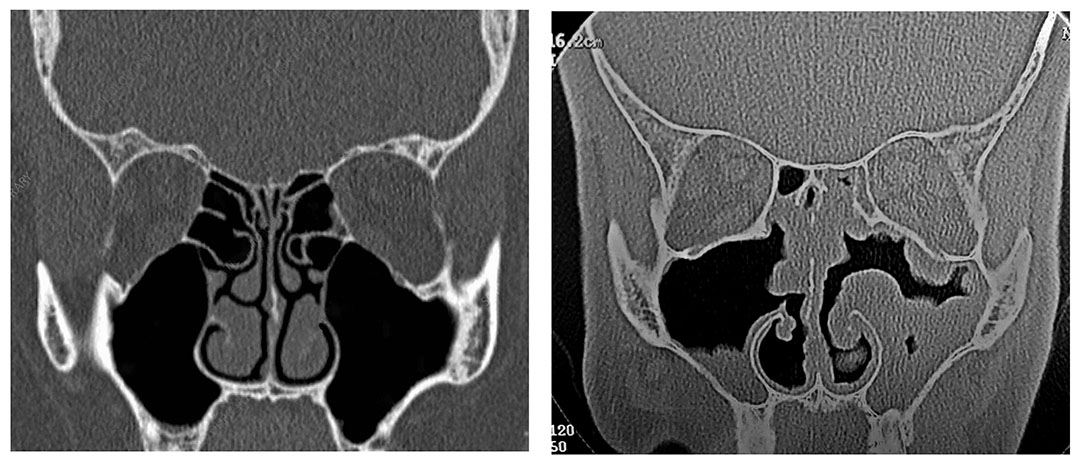
On the left, a CT scan of normal sinuses as if the patient is facing you. On the right, a 2003 CT scan of the author’s sinuses, showing his congestion even after operations in 1990 and 2000. Much of the blockage is not mucus but instead
saggy sinus tissues no longer able to shrink due to constant allergic inflammation.
photo credit: courtesy Antonio García |
When I found one in 1990, he examined me and
was amazed that I was a functioning being, much less an active trombonist. That
led in the same year to my first polypectomy (removal of growths) and submucous
resection (basically an “internal facelift” in which a large amount of sagging
nasal tissues are trimmed off so as no longer to obstruct the air passage). Because
during the surgery my sinuses had proven to be far more congested than the
doctor could tell from pre-op scans, I remained on the operating table twice as
long as predicted.
Having accomplished such a
clean-out, I expected immediate and profound changes in my playing once I was
allowed to resume on the horn. But there were none. My breathing and
tonguing initially found instantaneous ways to mimic my previous congestion,
generating the same level of sound-production issues I’d faced when I’d been
fully congested. I was surprised, frustrated, and I admit a bit angry. But
after a while, I came to my senses (literally, including my sense of sight with
my bread bag in hand) and began focusing intensely on pre-hearing the new sound
I wanted so that my brain would subconsciously open up my air-system to create that
desired tone and attack. Within weeks I was able to stabilize my sound production
to perform consistently far better than prior to my operation.
If only I could will my nose to cooperate similarly. Alas, my congested and infected sinuses called
for a second polypectomy and submucous resection a decade later, during my eight
years of full-time teaching at Northwestern University (where, in full circle
of life, my studio was next door to Dale Clevenger’s). I underwent surgery with
a new ENT over Thanksgiving break in 2000; and when I reported back to teach on
Monday, my colleagues marveled at how less-nasal my voice sounded—despite the
fact that the several feet of gauze-packings in my sinuses wouldn’t be removed
for another ten days. Once permitted to play trombone again, I had to follow my
pedagogical path of post-op-1990 in order to teach myself my new tone and
attacks; nothing came “automatically.”
When I faced the same
fate in 2010, during my 21-year-tenure at Virginia Commonwealth University, my
new ENT there politely called me a rare “three-time loser.” Music colleagues
sitting next to me in a quiet room had been able to hear my saggy sinus tissues
flapping when I breathed. A CT scan again showed the result of another decade
of constant swelling and shrinking due to allergens, resulting in sinus-linings
that would no longer shrink and so maintained blockages similar to deflated
balloons in each of my sinuses. I could not sleep more than an hour at a time.
The ENT actually prescribed that until I could time the operation, I should
allow myself to become addicted to Afrin, as its moderately shrinking effect on
my tissues allowed me two or three hours of sleep at a time—plus a bit of
relief when playing the trombone.
|
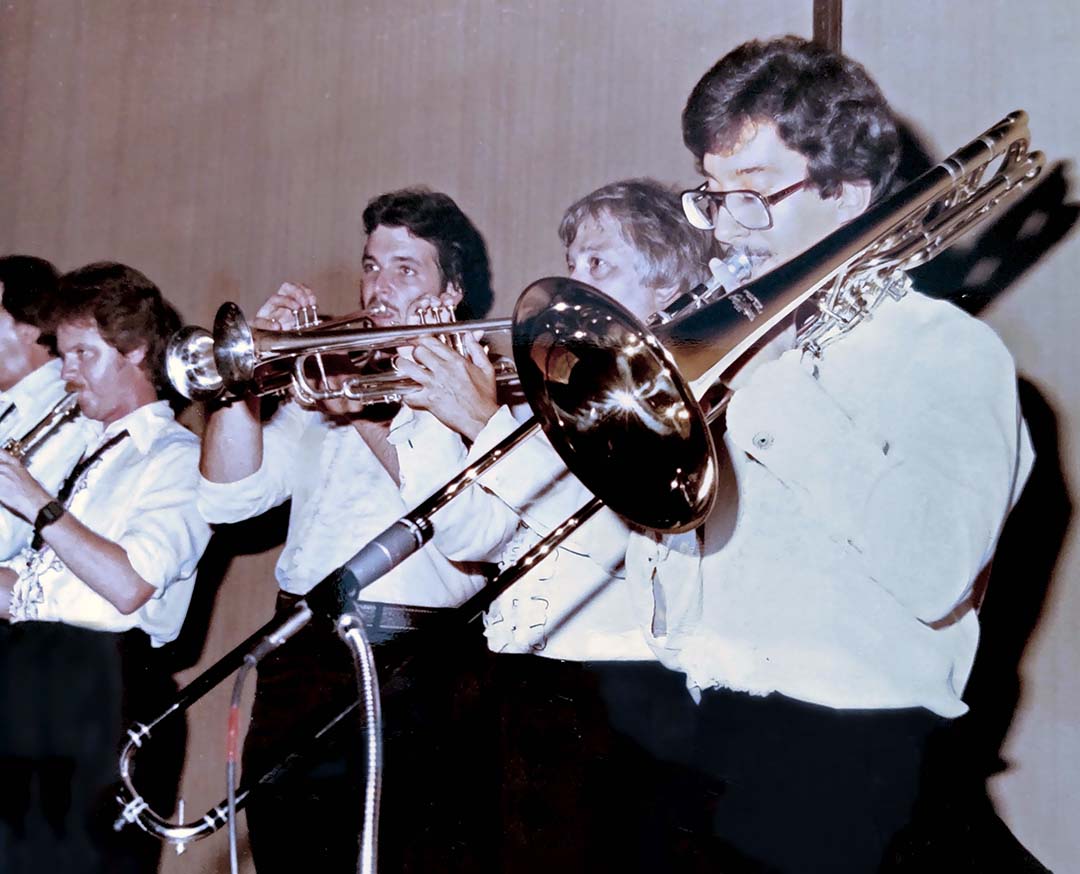
The author on bass trombone with the New Orleans pop band "Jubilation!," July 1982.
photo credit:
courtesy Antonio García |
My third polypectomy and submucous resection
that year again restored my breathing on an epic scale yet again had no effect
on how I
played the trombone. After each of these three operations I would subconsciously
tense my soft palette so as to replicate how I’d previously felt when
playing trombone. Raising the back of one’s tongue or soft palette does the
same as nasal congestion: it blocks off the “escape valve” of the nose. Thus
once again the nose couldn’t assist with venting some of the rush of air that I
was sending to my mouth to play the trombone, and so I was sending some of that
air backwards and into my stomach. I was subconsciously creating the artificial
resistance I needed in order to “feel” like I was playing the trombone
properly. The truth was that I had no idea what it felt like to play the
trombone as other players did. I had to work consciously to accept it feeling
differently, to play without the artificial blockage I was creating to
compensate for having clear airways!
My wind-playing path following each of these
operations proved thoroughly to me that as Jacobs and Erb had previously illustrated
to me, I possessed in my head what was needed to create beautiful tone and phrasing. Think sound!
My ENT’s goal and mine was for me not to face
a fourth-decade operation, and so far we have succeeded. My sinuses are clear,
and my only medication is a daily pair of Flonase sprays in each nostril so as to suppress the potential growth of polyps. It is
remarkable to me that in a given year I might take no more than a half-dozen
antihistimine pills. And due to enjoying my work as a player/teacher/writer (as
well as having at least some good genes), I went the last 34 of my 35
full-time teaching years without missing a single day for sickness. (Alas, in
my first year I’d neglected to get my flu shot!)
A Visual Remedy
The bottom line is that “snore-breathing” slows
down air when you inhale (because it can’t come in as fast as through
the mouth); slows down and misplaces air when you exhale (due to the
reduced air capacity of the nose and then the redirection of the excess back
into your stomach); and you’re leaving the back of your tongue up when
breathing; so often it gets in the way of air when you’re starting notes,
especially soft notes. (March 2026 Addendum: I realized just this month that when I drink quantities of water out of a glass—not through a straw or squirting out of a water bottle—I do so with my tongue up, touching the roof of my mouth, actually in the way of the water-flow. I'm sure I've done this all my conscious life. Why? Did I experience some sort of water-choking event as a youngster that prompted me to raise my tongue up while drinking just as I did while inhaling air? Or did my deeply rooted "snore-breathing" during sleep—that transferred over to my early trombone-playing—transfer over also to my drinking liquids out of a glass? Or do I recall this as training from my orthodontist when I was a teenager? I'll never know for sure. But I do know that while I have long trained my tongue to stay down while breathing in for trombone-playing, clearly the cue-response-reward for my swallowing gulps of water is still "tongue up"!)
To remedy "snore-breathing" while inhaling air, I have applied for my students and for me the
following potential remedy from Richard Erb’s instruction. Since many
windplayers suppress their windflow while sitting, I suggest you initially do
all of these exercises while standing. (To see brief videos
demonstrating the bag-breathing exercises, click on the linked examples below.
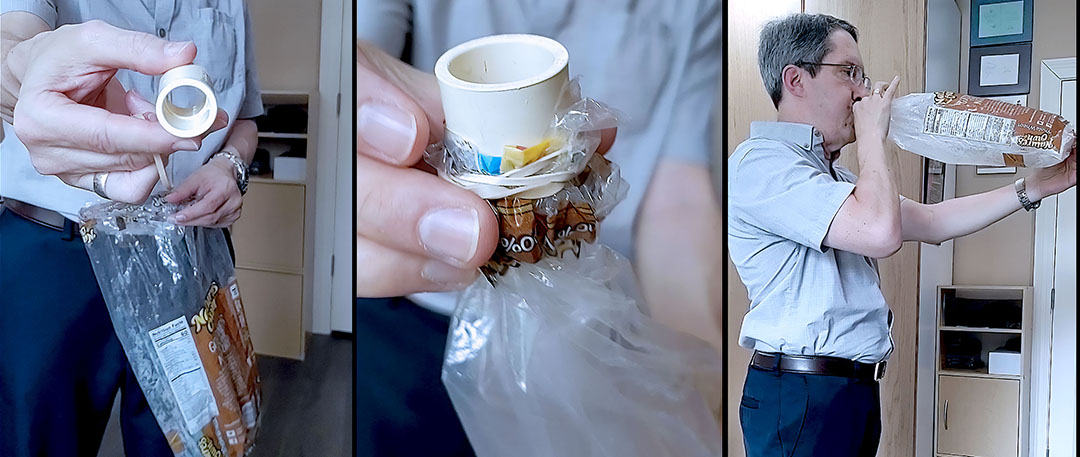
· Take a large plastic bag,
like that for a loaf of bread, big enough to handle a full exhalation of your
air. Shake out all the crumbs; press all the air out of it from the bottom up. Optionally
add a 1” diameter plastic tube at the top of the bag; rubber-band the edges of
the bag around the tube without constricting the bag. (This tube not only will
accept your mouthpiece but will promote “O”-shaped breaths without the
mouthpiece.)
|
Bread bag construction.
photo credit: courtesy Antonio García |
· Without the mouthpiece
included, take your left hand and clasp the open end to your mouth; hold the
closed end out with your right hand so the empty bag is extended parallel to
the ground as if a trombone or trumpet. Take a good breath; then exhale into
and inhale from the bag repeatedly without stopping: supposedly a closed system
of air. Does the bag instead get bigger and bigger as you proceed through
cycles of breathing? That means you're inhaling using not only your mouth but also your nose—and unfortunately, that means you're taking in a fraction of your available air; plus your tongue is up in the middle of your airstream. So...
· Your first goal is to
adjust your manner of breathing so that when you blow in and out of the bag,
the bag deflates back to original size. Try it on your own, perhaps alternating
repetitions of good and poor flow: breathe in as if you’re snoring a bit;
breathe out. Then breathe in as if you have as open a throat as you can
perceive—as an “Oooooooo” breath—and breathe out. It might take a few days to
do the latter consistently, but note how it physically feels different to
inhale this open way. Your sense of sight (the bag) will likely serve
you better than your sense of sound when journeying towards tongue-down
breathing, as you will have far fewer visual memories to overwrite than aural
memories. Still, your windflow should also sound different: air moving without
resistance is quiet rather than hissing over the teeth or tongue. Don’t worry
about proceeding with the following actions until you accomplish this one goal
consistently on the bag.
· Your second goal, only
after achieving the first, is to witness yourself breathing correctly in and
out the bag, then immediately in the next breath shift to buzzing a long tone on your mouthpiece (aside from the bag), blowing in the same open-throat
manner. Then attempt to take an open breath without the bag and deliver another
open long tone on your mouthpiece while only visualizing the movement of
air into the bag. You can even place the stem of your mouthpiece into the bag
so as to ensure that you use your sense of sight to confirm correct windflow
into the bag while you buzz. (This works just as well for a woodwind-player’s
ligature and the bag.)
· The third goal would be to
move from the correctly blown bag directly to buzzing a legato melodic line on
the mouthpiece (no bag) while visualizing the movement of air into the bag.
· Fourth would be going from
the correctly blown bag directly to playing a legato melodic line on the horn, again while visualizing the movement of air into the bag.
· Along the way, be
conscious of comparing how it feels to blow “snore-breathing” and then open—and
how the horn responds differently to you with the latter.
· Now that your windflow is
moving well while you stand, compare that output in the bag to what you create
while sitting. Stand; take a good “O”-breath; blow into the bag; and observe
how much air is in the bag. Then sit; take a good “O”-breath; blow into the bag;
and compare how much air is in the bag versus while standing. If it doesn’t
match, you’re likely slouching into your chair, thus compressing your lungs
into your stomach. I require my mentees to “sit as if standing from the waist
up.” Do so, and repeat the standing/sitting alternations until you generate as
much windflow sitting as standing. (You can utilize this step by itself to
check your sitting-windflow in your or your students’ playing. I find no
quicker way to prove this problem and solution than by incorporating one’s
sense of sight in this way.)
|
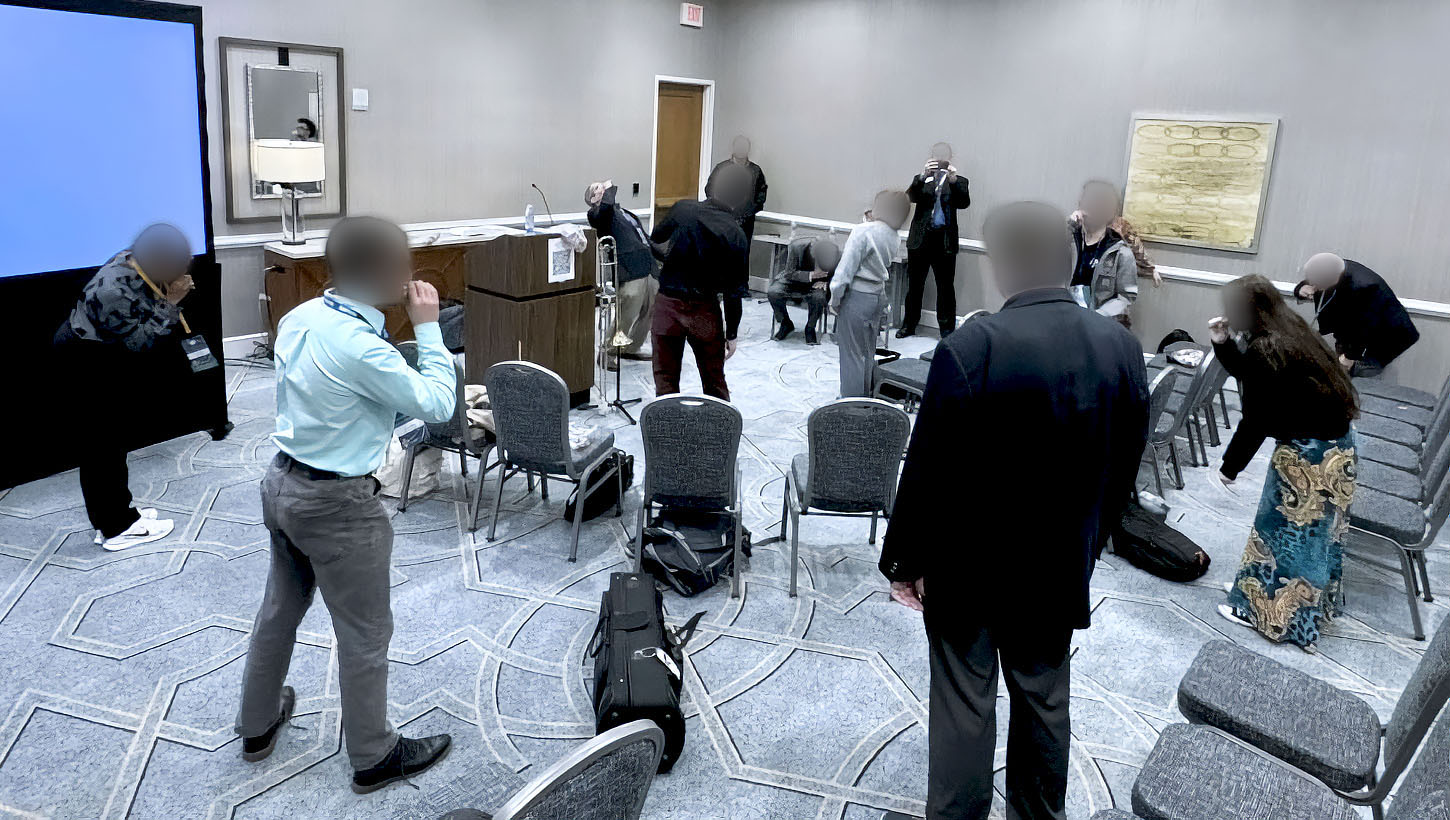
García (top, behind trombone) leads a group of music educators into gyrating while buzzing.
photo credit: courtesy Nick Volz |
· You may also want to
observe your windflow by buzzing through your mouthpiece towards the bottom of
a top-held sheet of paper. Play a long tone first. Then consider tonguing
(single, double, doodle) so as to confirm with your sense of sight that
your windflow does not suffer when you tongue. For an adventure, you can lie
down and attempt to sustain a ping-pong ball above your buzzed mouthpiece! While I don’t recommend doing this exercise for more than a minute at a time
(due to its unorthodox playing-posture), I have witnessed it freeing up the
breathing of so many of my students.
· You may also benefit by
borrowing a page from an athlete preparing to run a race. At times when I was
too tense to deliver my best windflow, Richard Erb would have me stand up with
my mouthpiece (no bag) and “gyrate” from the waist up while buzzing
enthusiastically, using huge breaths to the point of being somewhat hyperventilated
from the rush of oxygen. The gyrating-buzzing repertoire could be a long tone,
Rochut #2, or any other music—but always addressed musically. These
antics (not unlike a runner’s warm-up) tend to eliminate “snore-breathing” at
least temporarily; so then I’d grab my horn and play a long tone or a legato
passage, free of all the tension I’d previously had as a concerned
wind-player—and marvel at the resulting sound. (Gyrating while blowing into the
bag would also demonstrate to me how much more wind-capacity I had when I was
not tense!)
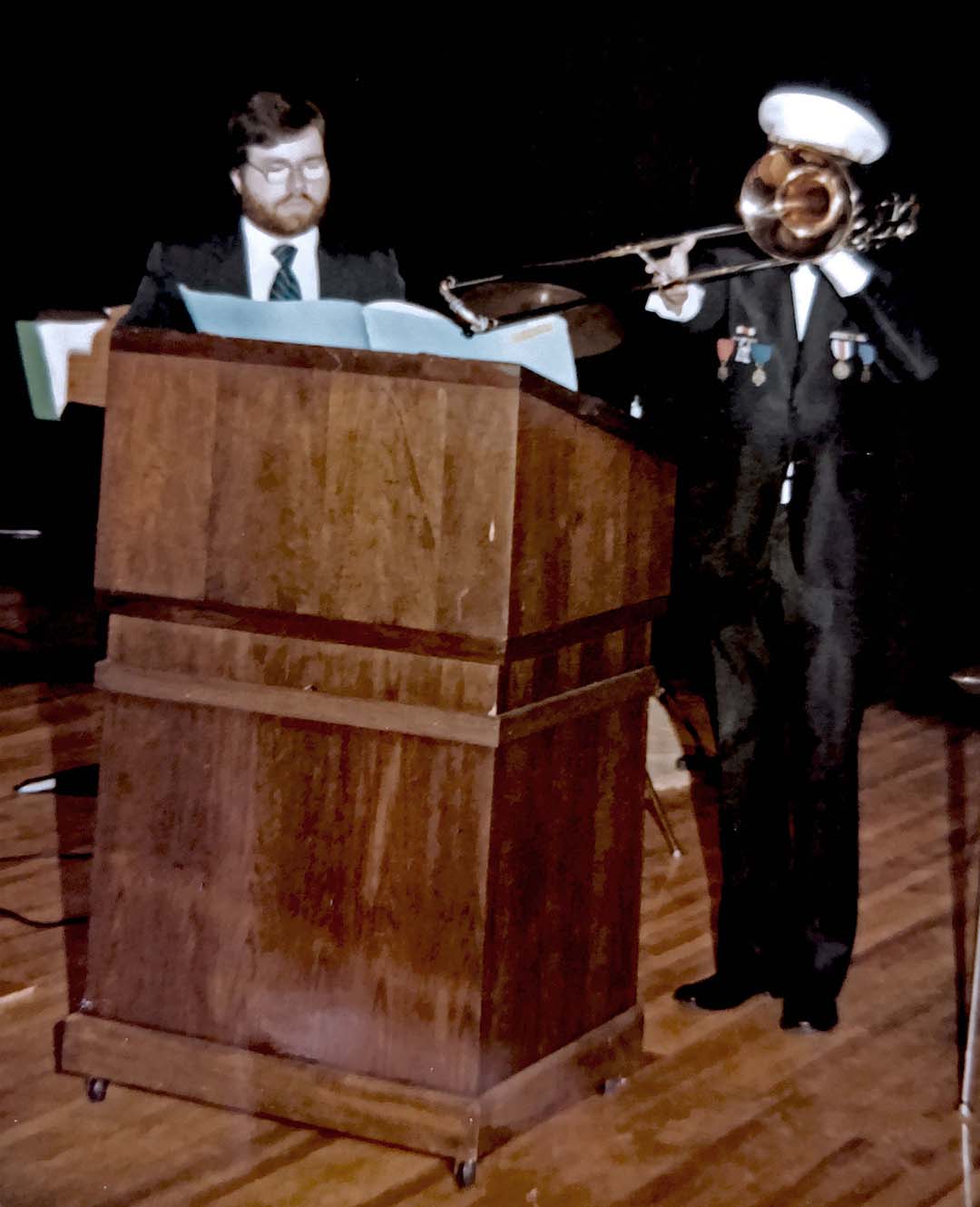
Performing Robert Erickson’s “General Speech” as General MacArthur on his senior recital, attended to by “Sergeant at Arms” Stephen Bertram, 1981.
photo credit: courtesy Antonio García
|
|
I’m betting you’ll be quite pleased. After the
above, when I ask students, “How did it sound?,” they overwhelmingly say, “Great!”
When I ask them, “How did it feel to play that way,” in vast majority they
respond, “Weird.” I then have to remind them: “Different doesn’t mean wrong; it
just means different. There are only two ways to determine if different is better or not: ‘Did you perform more in the intended style of the music?’; and ‘Is
anyone bleeding?’ If you sound more in the tradition of the music, and no one’s
hurt, chances are you’re onto something good.”
A concrete example of this style of analysis in my college
years stemmed from my own earlier-mentioned challenge of constriction of and
vocalization in the throat, particularly when tonguing. An undergraduate
colleague of mine (who much later studied with Jacobs), bassoonist Stephen
Bertram, once excitedly pulled me into one of Loyola’s listening-carrels to
hear a recording of Robert Erickson’s “General Speech,” as recorded by
trombonist Stuart Dempster (<https://www.sheetmusicplus.com/en/product/general-speech-22685391.html>, <https://www.scribd.com/document/681775535/Ericksson-General-Speech>). It required the performer to constrict
and vocalize sounds in the throat in order to achieve the avant-garde musical results.
When I shared the piece with my teacher, Richard Erb (who already knew of it),
he approved of my learning and performing the work as a means for me to gain
control over the very problems that had plagued my conventional playing. As
hoped for, once I had mastered the piece fairly well, I could turn the guttural
sounds on and off in my overall performing. Explorations of multiphonics
provided me similar on/off control of my vocalizations while performing. In
short, I believe there is no wrong way to play an instrument unless someone is
being hurt: there are merely “traditional” and “non-traditional” sounds. Our
mission is to deliver the sound appropriate to the music at hand.
Of course, individuals plagued with chronic nasal
congestion should also consider pursuing the medical remedies available to them
to improve their breathing. While doing so may not instantly translate to
better instrumental performance, it will literally open up passageways through
which you can consciously focus towards that improved performance.
Coda
In December 2023 I had reason to return for
the first time in decades to the Fine Arts Building (also known as The Artist’s
Studio Building), 410 South Michigan Avenue, Room 428, where I had experienced
such positive and profound changes in my trombone-playing in a very short time
under Arnold Jacobs’ tutelage—and where I’d immediately sit on the bench
outside his studio and write notes after lessons. I owe much of my productive
performance career as a tenor and bass trombonist to those few hours over 40
years ago, which had built so exponentially on my ongoing lessons with Richard
Erb. Partnered with my jazz trombone and composition lessons with Loyola’s John
Mahoney, further classical trombone instruction from Eastman’s George Osborn
and John Marcellus, writing mentorship from Eastman’s Ray Wright, Bill Dobbins,
and Manny Albam, and more formal and informal musical lessons from ensemble
directors, pedagogues, high school directors, and other artists too numerous to
count, I have been blessed with a creative performance, writing, and teaching
career far beyond my 20-year-old-self’s imagination.
|
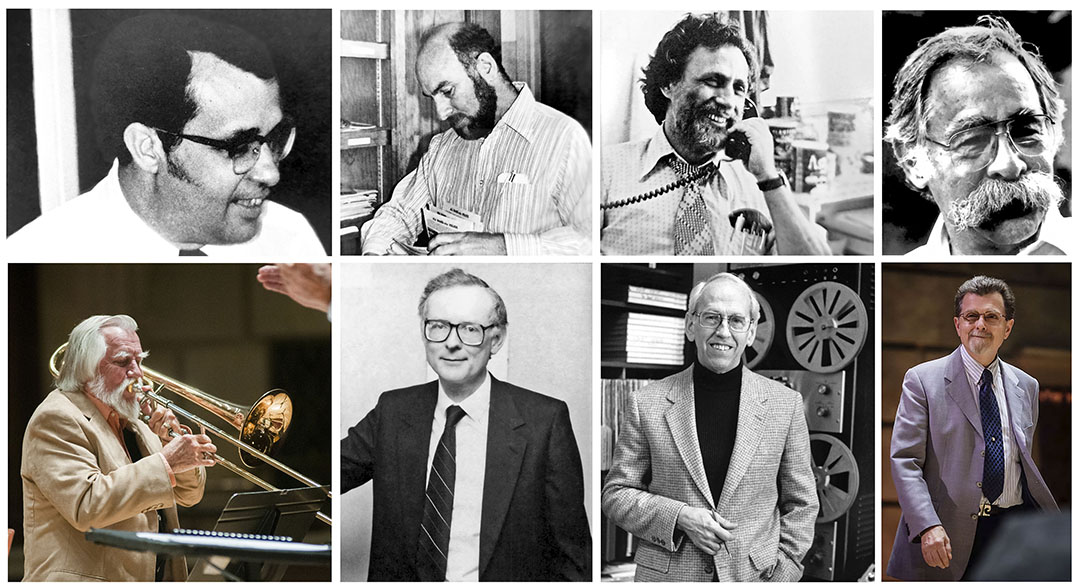
More of García’s formal mentors. Top row: Jesuit High School directors Marion Caluda and Logan Boudreaux,
Loyola theory Prof. Patrick McCarty, Eastman summer faculty Manny Albam.
Bottom row: Eastman graduate faculty John Marcellus, George Osborn, Rayburn Wright, Bill Dobbins.
photo credit: Antonio García |
* * *
|
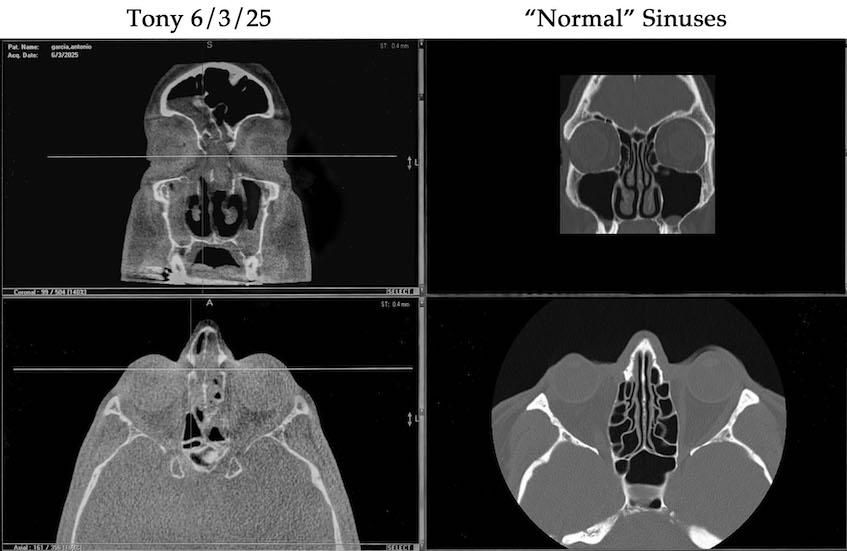
In the left column, two 2025 CT scans of the author’s sinuses (one facing head-on, one from above), showing his congestion even after operations in 1990, 2000, and 2010. This time the blockage is not mucus or saggy tissues but instead almost solely polyps. On the right, two comparative CT scans of normal sinuses from the same angle.
photo credit: courtesy Antonio García |
Postlude (since submitting this article to the ITAJ Journal and thus not in the printed edition)
I received a severe and productive cough starting April 5, 2025 that for the next six weeks
prompted some pain, retinal concerns (photopsia, fortunately not indicative of a loose retina), and of course some difficulty consistently speaking,
teaching, and playing the trombone. I visited my GP doctor as well as an ENT and ophthalmologist. In late April an x-ray had ruled out
walking pneumonia; my lungs were clear. Throughout this time I taught my occasional private students (including via Zoom) and was even live-interviewed for an international online conference, despite my vocal challenges. By late May symptoms had been
reduced to mostly a lingering and less productive cough.
In early June my ENT's follow-up included a CT head scan, which confirmed the presence
of a number of polyps in various sinuses—more than he could see previously
with an endoscope. As an illustration I have included the visuals at right, in which I show June's scans on the
left and a sample of "normal" scans on the right. The ENT said that the number
and size of these polyps are what have caused the substantial mucus that has prompted
my severe coughing.
The good news was—contrary to my scenarios 15, 25, and 35 years
ago—congestion did not fill my sinuses (likely because I am strict about
flooding my sinuses with saline when any congestion arises). And the lining of
my sinuses was not swollen and flabby and flopping into my sinus cavities
(likely because I have not been as allergic the last 15 years, not causing
constant cycles of swelling and shrinking of my tissues): the lining was fairly
normal. So the newer problem was largely just about polyps.
Thinking back on
1990, 2000, and 2010: just prior to those operations, the major positive difference this time was that my sleeping had rarely been affected; and I breathed through my
nose all the time during the day and night. That simply wasn't possible the
previous three occasions; so I hadn't thought that polyps could be the cause of
my recent cough issues. But the ENT's analysis, based on his scopes and scans,
was convincing.
My ears had not been affected this time, either. I'd flown in a number of planes over the preceding several months with no pressure-issues, to my delight. My voice had initially been quite affected, though, just as it had been at those earlier
benchmarks. The nasal polyps and subsequent postnasal drip had changed the resonance of my voice. That was largely resolved by May, but I was looking forward to getting the remainder back. I don't believe that the polyps had changed the outward resonance of my
trombone; but they did change how I felt and heard the trombone,
because the vibrations inside my head were quite different. And that in turn probably
affected how I then play the trombone. So I really looked forward to getting that entirely back—though again, by May I had largely already recovered from that state.
A variety of treatments were available. In late May I submitted a blood test to reveal how my immune system
was doing, and it turned out that my titers were a bit low and my IgE (Immunoglobulin E) level reciprocally several times higher than it should have been.
This meant my respiratory defenses needed a boost; so my ENT had me get a Pneumovax shot to raise those defenses and perhaps lower my body's mucus-reaction to my polyps as well as make later treatments
possible. In the world of unintended consequences, I also learned that ten weeks of cough medicines (both prescribed and over-the-counter) can quickly bring you five cavities! (Oh, yeah: corn syrup and sugar....) That was disappointing. And then in August I noticed a lump in my throat and the swelling of a lymph node on one side of my neck. Turns out that all that sinus drainage can infect your tonsils, and one of mine was not happy! So I had to address that as well—and did successfully.
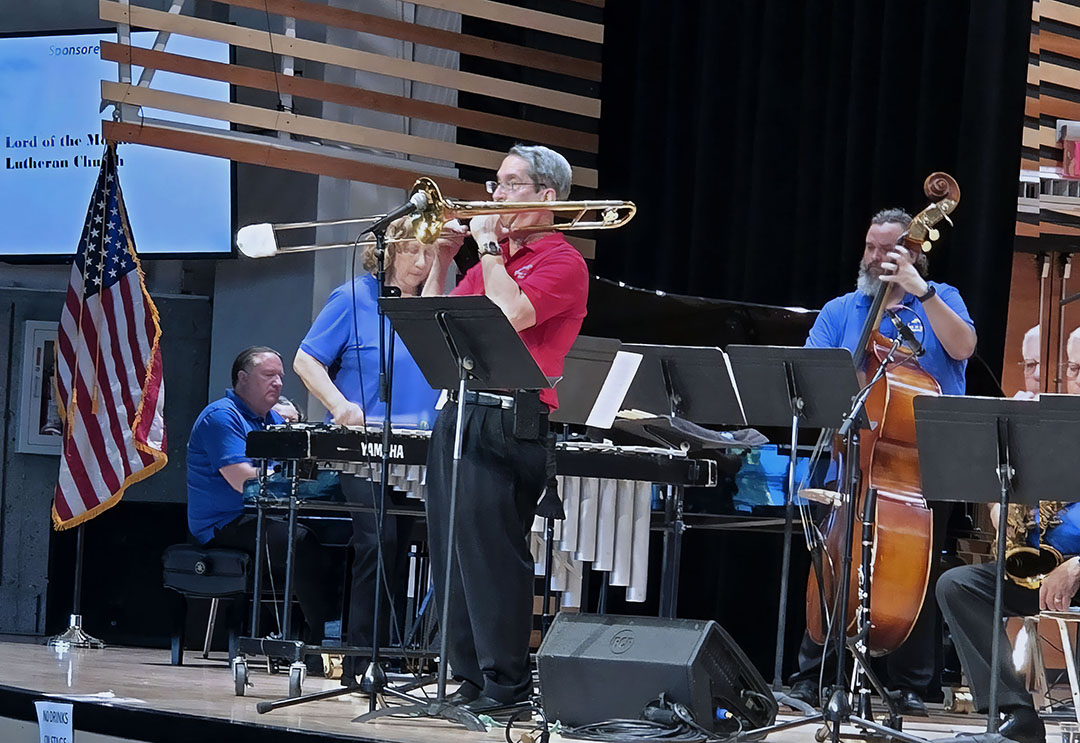
García performing with the Jazz at the Summit Big Band (CO),
June 2025.
photo credit:
Mary García |
 |
|
|
|
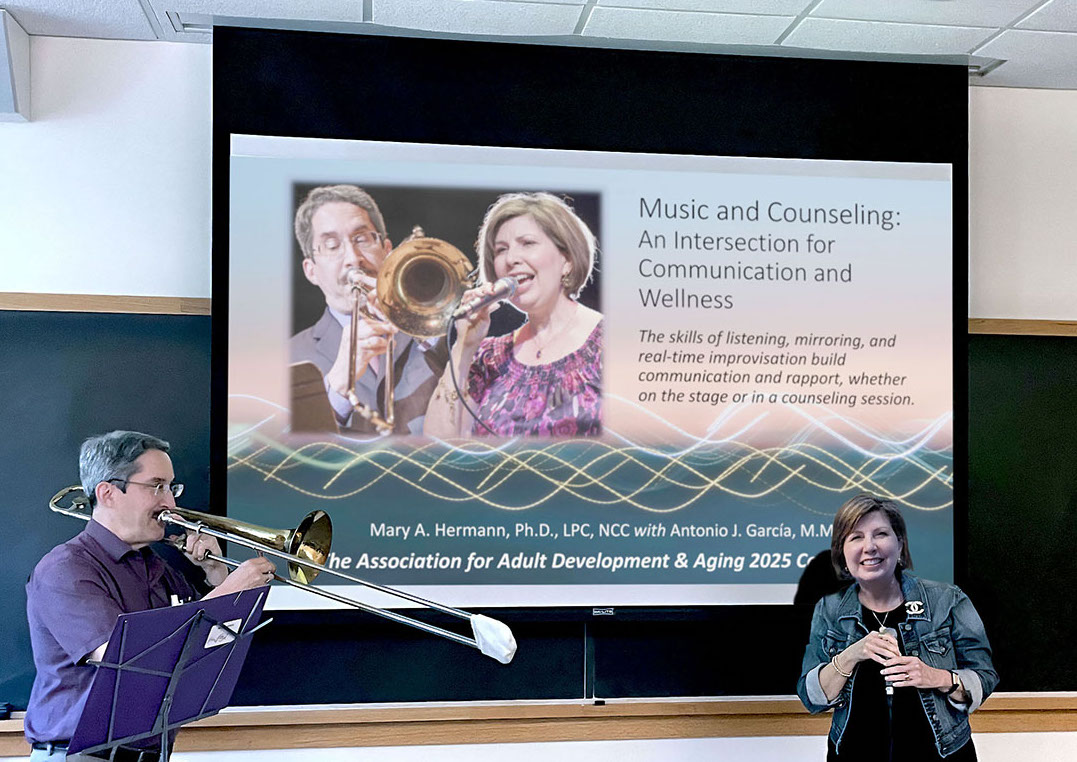
García performing with his wife Mary at the The Association for Adult Development & Aging 2025 Conference (GA), July 2025.
photo credit: courtesy University of the Cumberlands |
|
 |
Though I was now a "four-time loser" in nasal polyp-land, I could see my way out of this. And over the Summer of 2025 I had extensively taught and played my horn during residencies in Louisiana, Indiana, Colorado, and Georgia and thus confirmed that I could absolutely proceed with my usual music pursuits while seeking the remedy to my new nasal challenges. It's such a joy to teach, perform, and learn with colleagues and students far and wide!
October 2025 Update
In mid-August 2025 I underwent a polypectomy—my fourth! As during the previous three, the surgeon kept me under for longer than expected, as he found far more polyps than even the CT scans had shown. But amazingly, I had absolutely no pain after the surgery.
In my post-op appoinment with my ENT two days later, he was shaking his head: "You had some polyps. You HAD some polyps." But perhaps the most unanticipated detail was regarding my sceptum. For years scans have suggested that it had been somewhat deviated. But the doctor said that during surgery he had actually found it to be overrun with polyps, like barnacles on a boat, giving it the appearance in scans of a changed form and angle. So he used a device that scrapes polyps off without removing any tissue, and my newly buffed sceptum is just fine.
Unfortunately post-op I wasn't able to breathe much through my nose for a week, contrary to some past operations. This was because—since I'm a four-time polyp-loser—the doctor took every new-school and old-school step to ensure that I will have the best possible results, including leaving packs in my sinuses for several days. But by seven days after surgery, I was starting a saline rinse and was able to resume playing trombone; and by day ten, my sinuses were pretty clear; and my horn was sounding good. At the two-week mark I'd daresay there had already been some improvement in my playing versus pre-surgery. It was certainly fun to get back on the horn!
I've begun a saline/steroid rinse twice daily that should assist my sinus tissues' healing as taut as possible; and I am currently nose-breathing far better than pre-surgery. Most importantly, THE COUGH IS GONE! I've also started twice-monthly Dupixent shots to ensure that the healing forms
properly rather than as scar tissue or further polyps. I believe I'm now experiencing the maximum benefit from the surgery—and it's great!
November 2025 Update
Following the onset of some itching that I could only tie to the Dupixent (even though it is often used to relieve itching), I stopped using it; and the itching ended a couple of weeks later. I've completed my term of saline/steroid rises; so now I have no ongoing treatments other than a daily nasal steroid spray. All is well, and NO COUGH!
This entire matter, just as my earlier adventures, will offer me wind-experiences towards directly assisting my students. I imagine that not many other wind musicians have had as many medical challenges breathing in and out of an instrument and found medical and musical solutions. I consider myself fortunate to be able to apply these experiences towards the betterment of my own playing and that of my students.
* * *
Richard Erb.
photo credit: Michael Grose, courtesy Peter Erb
|
|
This article is dedicated to Richard Erb,
with whom I studied from September 1977-June 1983. He passed away April 25,
2023, leaving behind a legacy of so many accomplished low-brass musicians whom
he had mentored over his career at Loyola University New Orleans and for the
National Youth Orchestra of Canada, as well as decades of marvelous
performances as bass trombonist of the New Orleans Symphony and Louisiana
Philharmonic Orchestra. Read his article “The Arnold Jacobs Legacy,” published
in The Instrumentalist of April 1987 and republished that same year as a
chapter within the book Arnold Jacobs: Legacy of a Master by The
Instrumentalist Company. Text of that chapter can be found
online. View a lengthy video-interview with Erb
regarding Jacobs’ mentorship on TubaPeopleTV with Michael Grose. And in the December 1983 The
Instrumentalist you can read “The Dynamics of Breathing with Arnold Jacobs
and David Cugell, M.D.” by Kevin Kelly.
If you'd be interested in hosting a workshop
by Antonio García on this topic,
view the one-minute video at right.
|
|
_ _ _ _ _ _ _ _ _ _ _ _ _ _ _
Antonio J. García is a Professor Emeritus and former Director of
Jazz Studies at Virginia Commonwealth University, where he directed the Jazz
Orchestra I; instructed Applied Jazz Trombone, Small Jazz Ensemble, Jazz Pedagogy, Music
Industry, and various jazz courses; founded a B.A. Music Business Emphasis (for
which he initially served as Coordinator); and directed the Greater Richmond
High School Jazz Band. An alumnus of the Eastman School of Music and of Loyola
University of the South, he has received commissions for jazz, symphonic,
chamber, film, and solo works—instrumental and vocal—including
grants from Meet The Composer, The Commission Project, The Thelonious Monk
Institute, and regional arts councils. His music has aired internationally and
has been performed by such artists as Sheila Jordan, Arturo Sandoval, Jim Pugh,
Denis DiBlasio, James Moody, and Nick Brignola. Composition/arrangement honors
include IAJE (jazz band), ASCAP (orchestral), and Billboard Magazine (pop
songwriting). His works have been published by Kjos Music, Hal Leonard, Kendor
Music, Doug Beach Music, ejazzlines, Walrus, UNC Jazz Press, Three-Two Music
Publications, Potenza Music, and his own garciamusic.com, with five recorded on CDs by Rob
Parton’s JazzTech Big Band (Sea Breeze and ROPA JAZZ). His scores for
independent films have screened across the U.S. and in Italy, Macedonia, Uganda, Australia, Colombia, India, Germany, Brazil, Hong Kong, Mexico, Israel, Taiwan, and the United Kingdom. One of his recent commissions was performed at Carnegie Hall by the Orpheus Chamber Orchestra.
A Conn-Selmer trombone clinician, Mr. García serves as the
jazz clinician for The Conn-Selmer Institute. He has freelanced as trombonist,
bass trombonist, or pianist with over 70 nationally renowned artists, including
Ella Fitzgerald, George Shearing, Mel Tormé, Doc Severinsen, Louie Bellson, Dave
Brubeck, and Phil Collins—and has performed at the Montreux, Nice, North
Sea, Pori (Finland), New Orleans, and Chicago Jazz Festivals. He has produced
recordings or broadcasts of such artists as Wynton Marsalis, Jim Pugh, Dave
Taylor, Susannah McCorkle, Sir Roland Hanna, and the JazzTech Big Band and is
the bass trombonist on Phil Collins’ CD “A Hot Night
in Paris” (Atlantic) and DVD “Phil Collins:
Finally...The First Farewell Tour” (Warner Music). An avid scat-singer,
he has performed vocally with jazz bands, jazz choirs, and computer-generated
sounds. He is also a member of the National Academy of Recording Arts &
Sciences (NARAS). A New Orleans native, he also performed there with such local
artists as Pete Fountain, Ronnie Kole, Irma Thomas, and Al Hirt.
Most of all, Tony is dedicated to assisting musicians towards finding their joy. His 35-year full-time teaching career and countless residencies in schools have touched tens of thousands of students in Canada, Europe, South Africa, Australia, The Middle East, and across the U.S. His collaborations highlighting jazz and social justice have raised hundreds of thousands of dollars, providing education to students and financial support to African American, Latinx, LGBTQ+, and Veterans communities, children’s medical aid, and women in jazz. He serves as a Research Faculty Member at the University of KwaZulu-Natal. His partnerships with South Africa focusing on racism and healing resulted in his performing at the Nelson Mandela National Memorial Service in D.C. in 2013. He also fundraised $5.5 million in external gift pledges for the VCU Jazz Program.
Mr. García is the Past Associate Jazz Editor of the International Trombone Association Journal.
He has served as a Network Expert (for Improvisation Materials), President’s Advisory Council member, and
Editorial Advisory Board member for the Jazz
Education Network . His newest book, Jazz Improvisation: Practical Approaches to Grading (Meredith Music), explores avenues for creating structures that correspond to course objectives. His
book Cutting the Changes: Jazz
Improvisation via Key Centers (Kjos Music) offers musicians of all ages the
opportunity to improvise over standard tunes using just their major scales. He
is Co-Editor and Contributing Author of Teaching
Jazz: A Course of Study (published by NAfME), authored a chapter within Rehearsing The Jazz Band and The Jazzer’s Cookbook (published by
Meredith Music), and contributed to Peter Erskine and Dave Black’s The Musician's Lifeline (Alfred). Within the International Association for Jazz Education he
served as Editor of the Jazz Education
Journal, President of IAJE-IL, International Co-Chair for Curriculum and
for Vocal/Instrumental Integration, and Chicago Host Coordinator for the 1997
Conference. He served on the Illinois Coalition for Music Education
coordinating committee, worked with the Illinois and Chicago Public Schools to
develop standards for multi-cultural music education, and received a curricular
grant from the Council for Basic Education. He has also served as Director of
IMEA’s All-State Jazz Choir and Combo and of similar ensembles outside of
Illinois. He is the only individual to have directed all three genres of Illinois All-State jazz ensembles—combo, vocal jazz choir, and big band (plus All-County and community concert bands and orchestras). He is the recipient of the Illinois Music Educators Association’s 2001 Distinguished Service Award.
Regarding Jazz Improvisation: Practical Approaches to Grading, Darius Brubeck says, "How one grades turns out to be a contentious philosophical problem with a surprisingly wide spectrum of responses. García has produced a lucidly written, probing, analytical, and ultimately practical resource for professional jazz educators, replete with valuable ideas, advice, and copious references." Jamey Aebersold offers, "This book should be mandatory reading for all graduating music ed students." Janis Stockhouse states, "Groundbreaking. The comprehensive amount of material García has gathered from leaders in jazz education is impressive in itself. Plus, the veteran educator then presents his own synthesis of the material into a method of teaching and evaluating jazz improvisation that is fresh, practical, and inspiring!" And Dr. Ron McCurdy suggests, "This method will aid in the quality of teaching and learning of jazz improvisation worldwide."
About Cutting the Changes, saxophonist David Liebman states, “This book is
perfect for the beginning to intermediate improviser who may be daunted by the
multitude of chord changes found in most standard material. Here is a path
through the technical chord-change jungle.” Says vocalist Sunny Wilkinson,
“The concept is simple, the explanation detailed, the rewards immediate. It’s
very singer-friendly.” Adds jazz-education legend Jamey Aebersold, “Tony’s
wealth of jazz knowledge allows you to understand and apply his concepts
without having to know a lot of theory and harmony. Cutting the Changes allows music educators to
present jazz improvisation to many students who would normally be scared of
trying.”
Of his jazz curricular work, Standard of Excellence states: “Antonio García has developed a
series of Scope and Sequence of Instruction charts to provide a structure that
will ensure academic integrity in jazz education.” Wynton Marsalis emphasizes:
“Eight key categories meet the challenge of teaching what is historically an
oral and aural tradition. All are important ingredients in the recipe.” The Chicago Tribune has highlighted García’s
“splendid solos...virtuosity and musicianship...ingenious scoring...shrewd
arrangements...exotic orchestral colors, witty riffs, and gloriously
uninhibited splashes of dissonance...translucent textures and elegant voicing”
and cited him as “a nationally noted jazz artist/educator...one of the most
prominent young music educators in the country.” Down Beat has recognized his “knowing solo work on trombone” and
“first-class writing of special interest.” The
Jazz Report has written about the “talented trombonist,” and Cadence noted his “hauntingly lovely”
composing as well as CD production “recommended without any qualifications
whatsoever.” Phil Collins has said simply, “He can be in my band whenever he
wants.” García is also the subject of an extensive interview within Bonanza: Insights and Wisdom from
Professional Jazz Trombonists (Advance Music), profiled along with such
artists as Bill Watrous, Mike Davis, Bill Reichenbach, Wayne Andre, John
Fedchock, Conrad Herwig, Steve Turre, Jim Pugh, and Ed Neumeister.
Tony is the Secretary of the Board of The Midwest Clinic and a past Advisory Board member of the Brubeck Institute. The partnership he created between
VCU Jazz and the Centre for Jazz and Popular Music at the University of
KwaZulu-Natal merited the 2013 VCU Community Engagement Award for Research. He
has served as adjudicator for the International Trombone Association’s Frank
Rosolino, Carl Fontana, and Rath Jazz Trombone Scholarship competitions and the
Kai Winding Jazz Trombone Ensemble competition and has been asked to serve on
Arts Midwest’s “Midwest Jazz Masters” panel and the Virginia Commission for the
Arts “Artist Fellowship in Music Composition” panel. He was published within the inaugural edition of Jazz Education in Research and Practice and has been repeatedly
published in Down Beat; JAZZed; Jazz
Improv; Music, Inc.; The
International Musician; The
Instrumentalist; and the journals of NAfME, IAJE, ITA, American
Orff-Schulwerk Association, Percussive Arts Society, Arts Midwest, Illinois
Music Educators Association, and Illinois Association of School Boards.
Previous to VCU, he served as Associate Professor and Coordinator of Combos at
Northwestern University, where he taught jazz and integrated arts, was Jazz
Coordinator for the National High School Music Institute, and for four years
directed the Vocal Jazz Ensemble. Formerly the Coordinator of Jazz Studies at
Northern Illinois University, he was selected by students and faculty there as
the recipient of a 1992 “Excellence in Undergraduate Teaching” award and
nominated as its candidate for 1992 CASE “U.S. Professor of the Year” (one of
434 nationwide). He is recipient of the VCU School of the Arts’ 2015 Faculty Award of Excellence for his teaching, research, and service, in 2021 was inducted into the Conn-Selmer Institute Hall of Fame, and is a 2023 recipient of The Midwest Clinic's Medal of Honor. Visit his web site
at <www.garciamusic.com>.