This article is copyright 2008 and 2024 by Antonio J. García and originally was published in Down Beat, Vol. 93, No. 1, January 2026 in shorter form. It is used by permission of the author and, as needed, the publication. The expanded edition below includes text and materials not available within the print version. All international rights remain reserved; it is not for further reproduction without written consent. |
Organizing Short- and Long-Term Goals
by Antonio J. García
 |
Fun fact: My first published book wasn't about jazz; it was about organization. A few months before accepting my first full-time university teaching post |
Are you frustrated by not meeting your goals, time and time again?
Are you willing to spend one hour on an effort to prioritize and organize your life?
(For your own ease of process off-line, click here to download a printable PDF collection of these exercises to complete by hand as you read this article.
You can, however, see all the exercises below on this web page.)
We have all met individuals who could not capitalize on the opportunities that had come their way to expand their satisfaction with their career and/or life. We may have been or still may be that person. During my 30+ years teaching music industry courses, I coached my students as to how to accelerate the path towards their goals; but during my full-time teaching career, I refrained from writing an article on the topic. After all, my role was to help my students surpass the competition!
Now that I am not focused on any one institution, I thought it might be the right time to share my own ideas on this important subject. Perhaps the steps I outline below might assist you in capturing the most satisfaction out of your life, regardless of your occupation. Your goal is your happiness.
STEP 1—Self-Assessment: “What is Most Important to Me?”
Prepare a prioritized list illustrating how you currently spend your waking time in an average week, ranked from most time to least. Typical entries might include such things as work, practice, classes, and/or study (or one overriding career goal that encompasses those); being with family; relaxing with friends; being active in your chosen institutions (church, community); having alone-time; and the like. Be as accurate as possible. (We’ll assume everybody wants to eat and sleep; so leave those out for now—unless sleeping more than eight hours a day is a priority for you.)
List as few as five entries but no more than ten, and attach a percentage of your time to each that totals 100% (even though certainly that won’t be an exact accounting of your time). This may take a couple of drafts and scratch-outs, but the end result should look something like this (Figure 1):
AN AVERAGE WEEK OF MY TIME |
|||
Rank |
Activity |
% |
most |
#1 |
time |
||
#2 |
/\ |
||
#3 |
| |
||
#4 |
| |
||
#5 |
| |
||
#6 |
| |
||
#7 |
| |
||
#8 |
\/ |
||
#9 |
least |
||
#10 |
time |
||
TOTAL PERCENTAGE OF TIME |
100 |
||
STOP! Do not proceed to read further until you have completed the exercise above! No cheating! I mean it! Complete the above exercise now!
Done?
Now prepare a list illustrating what activities or goals you believe—regardless of time spent—are truly most important to you, ranked from most important to least. Entries might include any or all of the categories you’ve listed above, but add or substitute others below if they don’t show up above yet are important to you. Your goals should include the elements in life that would contribute most to your happiness!
Again list as few as five but no more than ten, and attach a percentage of your importance to each that totals 100%. This again may take a couple of drafts but in the end should look something like this (Figure 2):
WHAT’S MOST IMPORTANT TO ME |
|||
Rank |
Activity |
% |
most |
#1 |
imp. |
||
#2 |
/\ |
||
#3 |
| |
||
#4 |
| |
||
#5 |
| |
||
#6 |
| |
||
#7 |
| |
||
#8 |
\/ |
||
#9 |
least |
||
#10 |
imp. |
||
TOTAL PERCENTAGE OF IMPORTANCE |
100 |
||
Now compare the two, which might look like this (Figure 3):
AN AVERAGE WEEK OF MY TIME |
WHAT’S MOST IMPORTANT TO ME |
||||
Rank |
Activity |
% |
Rank |
Activity |
% |
#1 |
#1 |
||||
#2 |
#2 |
||||
#3 |
#3 |
||||
#4 |
#4 |
||||
#5 |
#5 |
||||
#6 |
#6 |
||||
#7 |
#7 |
||||
#8 |
#8 |
||||
#9 |
#9 |
||||
#10 |
#10 |
||||
TOTAL PERCENTAGE OF TIME |
100 |
TOTAL PERCENTAGE OF IMPORTANCE |
100 |
||
Food for thought:
- What does this comparison tell you?
- Does how you spend your time reflect what’s most important to you? After all, your goals should include the elements in life that would contribute to your happiness! I didn’t pick them: you did.
- If your time spent does not reflect your important goals, why not? Are you lying to yourself about what’s most important to you, just listing “important” topics that you think you or others want to hear? Be honest with yourself in this process.
- Perhaps you already knew that your average week is out of balance. But how long do you expect it to be so before you re-balance it: weeks, months, years? It’s common to compromise your balance for a period of time to address a specific goal over another. But for how long?
Look: there’s nothing wrong with your making the most relaxing, non-constructive use of your time—IF that truly matches your goals. If so, you should be a very happy person. But if you’re frustrated at not achieving your goals and have now discovered that you’re not actually devoting anywhere near proportionate time to those goals, you now know a lot more about why you’re frustrated. It’s not so much that you haven’t met your goals yet. (Who has? Anyone who does then comes up with new goals to pursue.) What really frustrates you is that you’ve been concealing from yourself that you’re not applying yourself towards your most important goals: that eats away at anyone’s peace of mind.
People who have no goals and can live that way should be content. But the rest of us, take note: people who have not yet achieved their goals while heartily pursuing them are typically happier than people who have goals but don’t work sufficiently towards them.
STEP 2—Self-Banking: “How Do I Allocate?”
A common phrase applicable to many challenges is “time and money.” To attain a typical goal, you often need some combination of time and money. And here’s how you attain them to a reasonable, useful degree:
· Repeat the following several thousand times: “I may have little control at the moment as to how much money I make. But I have much more control over how much I spend.” How much money you make is of no use if you’re not able to spend it towards a goal. After all, your goals should include the elements in life that would contribute to your happiness! The news is full of stories of people who “had it all” but then lost their fortune—and also full of stories of people who didn’t earn much money who nonetheless managed to save a lot and accomplish great goals (even giving away a lot of their saved money towards a good cause).
· Repeat the following as many times: “I will pay myself first.” You pay your rent, your electric bill, your credit-card bill (I hope). Do you pay yourself? Do you allot money out of your income to give to yourself, to your savings? Why are you paying the shop online or at the mall, the local bar, the hi-tech store all your money for things that don’t fit your goals? Are you important in this picture? Then pay yourself first. Put yourself before the material goods and luxurious services you might want—unless one of your most important goals is indeed the material goods and luxurious services.
· Pay yourself TIME first as well as money. Just as you can allocate your income, you can allocate your time. Time is valuable. Spend it where it does you good; save it as it benefits you; invest it wisely. I’m not suggesting that relaxing is wasting time: quite the contrary. Relaxing is not only important; it’s a necessity—it’s not a waste of time. (You know which of your activities waste your time.) As life gets more complicated (and it usually does), you have to plan more for it by avoiding the activities that make you less happy than achieving your goals would. After all, your goal is your happiness.
STEP 3—Self-Limitation: “I Can’t Keep It All In My Head!”
“OK, great. I’m convinced I can re-allocate my time and money in a way that will make me happier—and might even allow me to relax as much or more in the ways I ultimately want. But how do I go from the motivational ‘rah-rah’ to a plan that will get me moving directly toward my goals?”
Most people kick themselves for not being able to plan well. But in my opinion, most people could plan really well. The problem is merely that they can’t keep it all in their heads; so they beat themselves up. But they shouldn’t. I don’t keep it all in my head, and I’m pretty well known for my organizational skills. (If you can keep solely in your head the plan you’re about to create, you don’t need to be reading this article.)
So how do I do it? Here’s how.
First,
allow me to share with you what someone (I know not who) probably centuries ago
realized is the life cycle of any idea, project, or goal:
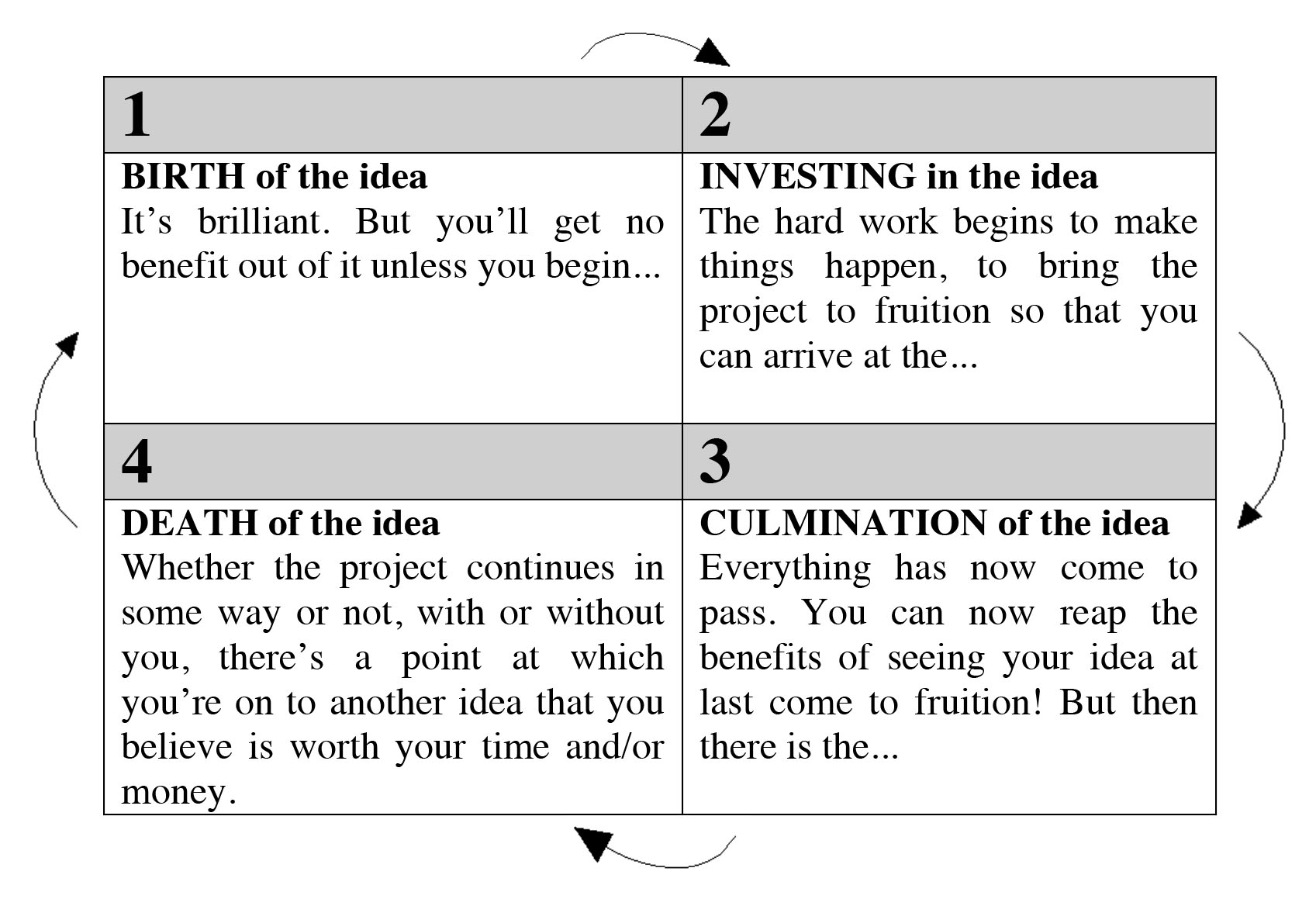 |
So you return to Phase 1 in the above cycle, but with another goal or project in mind. And you get that rolling into Phase 2 or maybe 3, by which time you’ve got another great idea, which enters Phase 1 while other projects are already into Phases 2, 3, or 4—and so on. Before long, you’ve got a dozen important goals underway, each seemingly at different micro-phases of the above “life cycle.” Now who can keep all that going in their head? Not I. But I can still get the projects done.
So can you, but not by overloading your brain. You need a plan—and you need some paper or a device; or else your head might explode.
STEP 4—Self-Organization: “How Do I Plan?”
Take another look at your earlier list of what’s most important to you. Think about those and make a list of related goals (some perhaps exactly as on that list, some perhaps a subset of an element on that list) according to which you believe you should be attempting to accomplish in the shorter-term (say, within a month or less) and which in the longer-term (say, six months to several years out). Then add your targeted completion date, perhaps something like “two weeks from now” or “two years from now” (or better yet, showing the actual resulting date). Your list might look like this (Figure 4):
SHORT-TERM GOALS |
COMPLETION DATE |
LONG-TERM GOALS |
COMPLETION DATE |
Now we need an example of a project to work on. So select one of your long-term goals, one that you expect means you’ll have to achieve a half-dozen or so mini-goals or steps along the way in order to get the big, ultimate goal done on time.
Let’s say that your big goal is eighteen months from now; and in order to get there, you have to accomplish smaller step-goals by one, three, six, ten, fourteen, and seventeen months from now. You’re going to need those step-goal dates in your calendar.
"It’s been 11 years since I took your Music Business course, and I’m STILL utilizing pretty much everything you taught in my day-to-day activities. Now in my fifth year as an Associate Professor in Music Technology, I’ve been passing along your wisdom to my students and have had incredible success. Since graduating from VCU, I've gone through ‘Tony's Tips for Organizing Short- and Long-Term Goals’ every three months. Even though I’ve read the thing top to bottom countless times, I still go in reading it fresh every time; and it’s saved my tail more times than I can count: prof duties, gigs, freelance deadlines, you name it! Thank you for sharing it with our class; I hope it’s still impacting people today." |
But that’s not enough. How many times have you arrived at a date on your calendar, found a deadline, and thought, “Darn! I didn’t prepare for this deadline. I should have thought of this two weeks ago—or a month ago—so that I’d be ready.” Exactly! So you’re going to need some “warning” notations in your calendar in the weeks preceding each of those step-goals so that you can think ahead to your deadlines in time.
How far ahead you want such a warning to appear will vary with the event and its related work. But this “Backdated Calendar” is the most essential part of my own planning and success. And I’m betting that if you do it, you will find that you will arrive unprepared at far fewer deadlines. You might even be prepared for all of them!
Now, remember the “life cycle of an idea” and how you’ll have multiple projects going, each at their own stage of development in the life cycle? So you’re going to have multiple goals in your calendar, each with its own step-goals—and each of those with their own warnings! And this “Backdated Calendar” is how you can keep the ball rolling on many simultaneous projects without feeling as though you have to keep it all in your head.
In this digital age, a terrific help is that you can make a calendar entry in a computerized calendar, such as “DEADLINE: submit grant app!” E-copy that text and e-paste it backwards into a warning-date’s entry, adding, say, “2 weeks to,” resulting in “2 weeks to DEADLINE: submit grant app!” You can then e-copy that text and e-paste it further backwards into a warning-date’s entry a total of four weeks previous to the deadline, then changing only the initial digit, resulting in “4 weeks to DEADLINE: submit grant app!” It saves you a lot of time not to have to re-type everything. Nowadays you can probably ask AI to automate the entries! (You can of course do this all manually on a paper calendar as well: I used to!)
So let’s review sample entries that might result from just one project: the one we mentioned where your big goal is eighteen months from now; and in order to get there, you have to accomplish smaller step-goals by one, three, six, ten, fourteen, and seventeen months from now. Let’s say it is a grant application; and let’s assume that today is January 1, with an application deadline of July 1 the following year. Your calendar entries might look like this (Figure 5):
DATE |
CALENDAR ENTRY |
1/1 this year |
4 weeks to collect all grant application papers! |
1/15 |
2 weeks to collect all grant application papers! |
2/1 |
Collect all grant application papers! |
3/1 |
4 weeks to complete first draft of grant app! |
3/15 |
2 weeks to complete first draft of grant app! |
4/1 |
Complete first draft of grant app! |
6/1 |
4 weeks to collect consents to be interviewed for grant app! |
6/15 |
2 weeks to collect consents to be interviewed for grant app! |
7/1 |
Collect consents to be interviewed for grant app! |
10/1 |
4 weeks to complete site visits for grant app! |
10/15 |
2 weeks to complete site visits for grant app! |
11/1 |
Complete site visits for grant app! |
2/1 next year |
4 weeks to final interviews for grant app! |
2/15 |
2 weeks to final interviews for grant app! |
3/1 |
Conduct final interviews for grant app! |
5/1 |
4 weeks to gathered final grant documents! |
5/15 |
2 weeks to gathered final grant documents! |
6/1 |
4 weeks to DEADLINE: submit grant app! Gathered final documents? |
6/15 |
2 weeks to DEADLINE: submit grant app! Proofed all pages? |
6/22 |
Submit grant app early! |
7/1 |
DEADLINE: submit grant app! |
You might need more warnings; you might need fewer. But I think you can see what I’m getting at. Can you imagine trying to keep all that in your head: no way! But if it seems simple, remember that you also have such step-goals and warnings in your calendar for all your other projects! That’s complex; but you’ll find that you have measured out your overlapping plans in a doable fashion—and you often wake up with an instant agenda as to what you need to do in order to accomplish your most important goals in life.
To offer a musical analogy, I point to a statement I believe Chicago Symphony Orchestra trombonist Michael Mulcahy made when asked how he attempts to stay calm, say, while waiting for the challenging “Bolero” solo to arrive at his point in the music after many, many measures of rest. To paraphrase, he said, “Look: you have two options. One is that you can think about yourself and how nervous you are. The other is to do your job: to think about the music. Listen to the orchestra performing around you; and let it prepare you by providing you with the style, the tempo, the pitch. That will give you the best odds for your playing the solo properly, anyway. Doing your job means thinking about the music, not about you.”
It’s the same thing in organizing your goals, priorities, and your resulting calendar. You can spend your life thinking about how challenging or even terrifying it is not to have achieved your goals yet or have known where your future lies. Or you can do your job, which is to accomplish steps towards those goals. By waking up each day with an agenda that will bring you closer to fulfillment, you’re not thinking so much about how nervous you are: you’re focusing on the task at hand. And if today’s task means a well-earned morning or day off, well, so much the better for having budgeted the time to make that happen!
This process of breaking down a big project into goals, step-goals, warnings, and then backdating a calendar makes what I do possible. And I use some degree of it for even the smallest deadlines: it is very rare for me to place any small deadline in my calendar without immediately adding at least one preceding warning-date in my calendar as well—I don’t like being surprised on the day of a deadline! So if you look at my datebook, you’ll see such “warning” reminders all over it—plus many overlapping goals, step-goals, and warnings related to different projects.
THAT’S how I stay organized and on task to meet my goals.
STEP 5—Self-Discipline: “How Do I Stick to My Plan?”
Can we agree that you have available a finite amount of time and money? Well, then, back in Step 2 (Self-Banking) we explored how you have to “pay yourself first,” both in time and money; or you won’t have any left for yourself after you pay everyone else your time and money!
When I foresee an area of the calendar that’s really going to be “crunch time,” I’ll go as far as “protecting” an area of my calendar. I’ll mark some hours “HOLD for Writing Project,” “HOLD for Practice,” or “HOLD for Time with My Wife.” Because if you can already foresee by your deadlines and step-deadlines on the calendar (including family obligations and good times) that you’re going to have so little time to spare that week, why wait until that week to address it? The time is now, planning ahead, to mark off and protect the time you need to set aside to get your goals done.
Nonetheless, as we all know, life changes every day; and we have to adjust our plans, re-allocating time and money as we go. Fine. But time and money are each on budget: if you subtract from either here, you have to repay the same over elsewhere; or you’ll be frustrated at not reaching your goals. And that’s where your self-discipline comes in. Do you have any? That’s not a flip question. Do you have self-discipline?
If you don’t, you’ll need to find some. If you do have it, here’s where you’re going to need it—making up for lost time, for example. Because life demands that you prove to yourself again and again that you really want these goals, that you’re willing to make ongoing adjustments to achieve them. Or you discover that you don’t really want them, because you’re not willing to work for them—in which case you still have an answer that will lead you out of frustration, just to a different destination than you’d thought. How badly do you want this goal—or not? There’s nothing wrong with discovering that what you thought you’d wanted isn’t really the case anymore, so long as you find out as soon as possible in your journey.
And even then, if you find out years later than you’d perhaps wished, you’ll have learned a lot of useful things along the way—including what you really want. I recall the recurring “Dear Abby” column in which a person writes in something like, “Dear Abby: I’m a successful career woman in my thirties, working in the insurance industry. But I’ve recently discovered in myself a strong yearning to become a doctor. My friends think I’m nuts: by the time I finish prerequisite courses, get in and out of medical school, and complete my residency, I’ll be 45 and in great debt! What should I do? —Torn in Texas.”
And Abby replies to the effect of, “Dear Torn: You’re going to be 45 by then, anyway. The question is, will you be happy in life at 45 in your current field or in medicine? And will you be happy now, much less at 45, if you don’t check this out? Pursue what will make you happy, whether that’s staying where you are or shifting to this new career path. Being unhappy at any age is not the goal.”
EPILOGUE
I’m not perfect in my organization: far from it. As I’ve told many people: “I make mistakes frequently. It’s just that I’m usually the first person to discover them; so I can fix them before anyone else notices.” And that’s very true. With a solid foundation of knowing one’s goals, how one prioritizes and allocates one’s time, how the cycle of a project runs, how to backdate a calendar (with warnings), and how to stick to one’s plans and see them through, you will have enough going for you that the inevitable human error that comes along will not completely derail your mission. But if you decide you’d rather not follow the suggestions I’ve offered, that’s fine. Don’t feel guilty—so long as you have a better plan to follow.
Finally, I’m not egotistical enough to suggest that I’m the only one who can offer you the tips I’ve provided here. But I am savvy enough to know that many, many of your competitors can’t imagine—or won’t choose to accomplish—the steps I’ve outlined for you here. True story: a dozen years or so ago, a former jazz student of mine contacted me. He was working full-time for a large, IBM-like corporation, getting paid handsomely to present 4-day organizational workshops to the employees so as to get them on track. (That supported his jazz-playing habit!) And he wanted to know if I’d might want to have him come visit VCU and do a 2- or 4-day organizational workshop for the Music students there.
I looked over his materials, then replied to him attaching a copy of basically the material I’ve provided you today. I told him I thought he was doing great things, that I was attaching a handout he’d received from my Music Industry class circa 2005, but that I wouldn’t need his services at the time.
There was a lot of overlap—a WHOLE lot—between his materials and mine, even though it was more than a dozen years after he’d been in my Music Industry class. He hadn’t intentionally plagiarized my approach and hadn’t kept the original handout; it was simply so ingrained in him that he’d thought he had come up with it on his own. I considered it an instructional compliment. Aside from all the musicians I’ve mentored, I know I’ve made a corporate impact!
I am confident that if you apply these techniques, you will achieve your goals more quickly and be happier along the way—because your goals should include the elements in life that would contribute most to your happiness! Enjoy your path.
(As noted above: for your own ease of process off-line, click here to download a printable PDF collection of these exercises
to complete by hand as you read this article.
You can, however, see all the exercises above on this web page.)