In Passing: Ron Modell, and More
by Antonio J. García
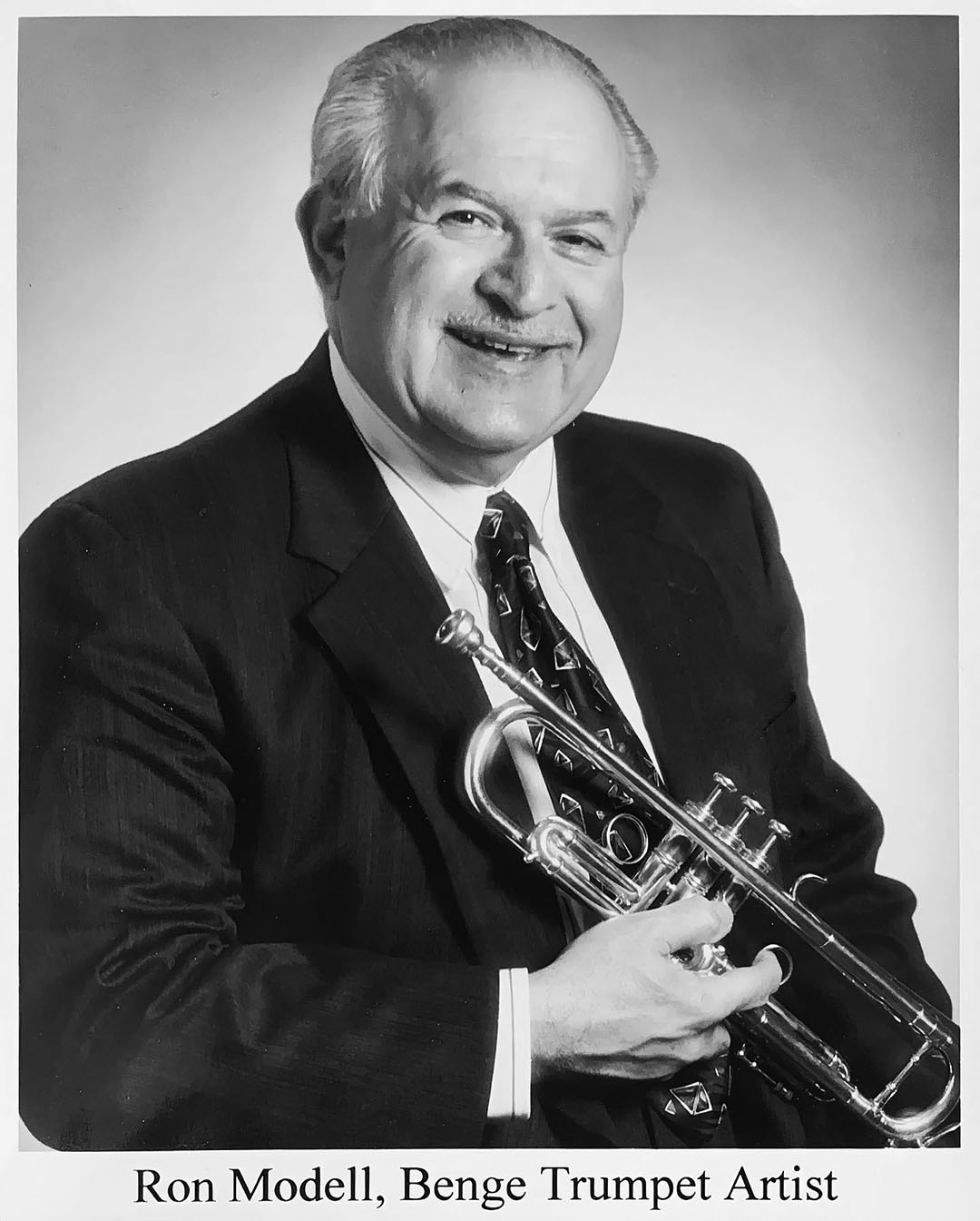 |
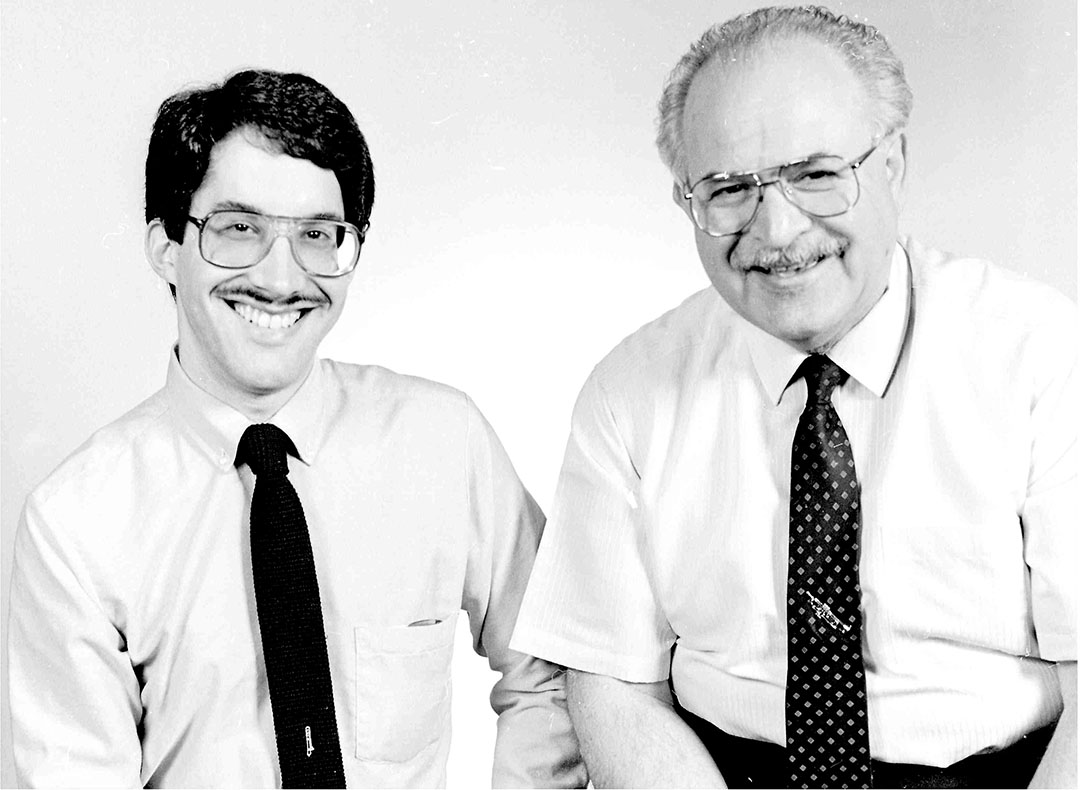
| Ron's professional photo. |
|
This article is copyright 2025 by Antonio J. García and originally was published in the Northern Illinois University Arts Blog, November 2025. It is used by permission of the author and, as needed, the publication. All international rights remain reserved; it is not for further reproduction without written consent. |
In Passing: Ron Modell, and More
by Antonio J. García
|
| Ron's professional photo. |
Jazz education lost a giant in the field with the passing on June 10, 2025 of my friend and colleague Ron Modell.
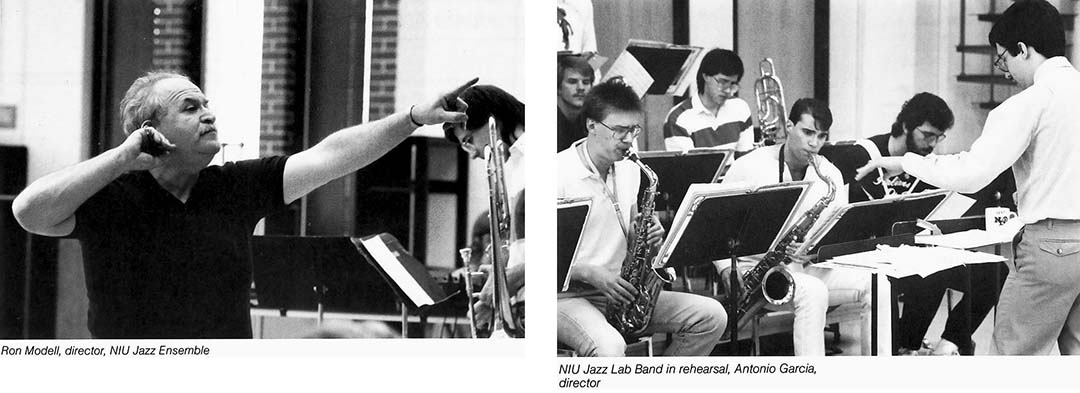
Ron joined Northern Illinois University’s faculty in 1969 after a performance career that had already included touring as a teenager with Cornelia Otis Skinner, performing Afro-Cuban music in New York City with Machito, and serving as Principal Trumpet of the Dallas Symphony for nine years. That diverse background of theater, jazz, and classical excellence came into play when he founded NIU’s Jazz Ensemble, which quickly became one of the premiere college jazz bands in the world.
In addition to the expertise that he and his eventual jazz colleagues brought his students, the band benefited immensely from Ron’s effective fundraising, which allowed him to bring such guest artists to his students as Dizzy Gillespie, Duke Ellington, Carl Fontana, James Moody, Conte Candoli, Clark Terry, Jon Faddis, Rob McConnell, and Marvin Stamm, to name a very few. Many of those artists were in residence with the band for a week, rehearsing, touring, and teaching with the ensemble. What an incredible opportunity! Again, NIU did not fund the vast majority of these visits and outreaches: Ron externally raised the money himself.
For decades he accomplished this while his primary teaching load was actually classical trumpet, playing in faculty brass ensembles. His part-time jazz focus was increasingly aided by other faculty whose load was primarily non-jazz but offered superb jazz instruction as well.
To demonstrate more about Ron’s character and skills, I’d like to share with you how I met him. It’s a longer but I think interesting tale. It will explain why, of all the many terms I could use to describe Ron, I would have to first choose “generous.”
In 1986 NIU decided to support Ron’s work with its first full-time jazz faculty member. I researched the music program, the school, the faculty, and some recordings of the jazz ensemble and was knocked out. So I applied, fresh out of graduate school, and made it through to the on-site interview process; but the post went to Mike Steinel. Mike had been part-time on NIU’s faculty; thus he transitioned to full-time. But at the end of the following academic year he then announced that he would be leaving to take his dream position at his alma mater, the University of North Texas.
So NIU’s position arose again for Fall 1987. This time the job description had grown into a Coordinator of Jazz Studies, NIU’s first, as the school had just passed a new curriculum for undergraduate study there. While interviewing for a post at Memphis State University, I received an invitation to revisit Northern and soon did so.
In neither year of interviewing did I meet Ron. He had other standing obligations during those parts of the summer; and despite all the love and effort that he’d clearly put into jazz at NIU, he fully trusted his colleagues on the search committee to bring in someone right for the job. That says a lot about his strong relationship with his fellow faculty members.
I believe it was in mid-July that I received word that I’d merited the job—but only if a current state hiring freeze would be lifted! Each week I’d check in with NIU from my New Orleans home, and each week I confirmed the freeze was still in effect.
Until finally it wasn’t. I was officially hired two weeks before the start of the Fall 1987 semester. I packed up for the drive and arrived in DeKalb, IL one week before school started, my most crucial resources in my car trunk, the rest of my belongings shipped to a loading dock in nearby Aurora, IL, where they awaited my new address.
I had none. It was the largest freshman class in 100 years at NIU, and every half-suitable apartment had long been rented out. I started by living in the Music Chair’s basement for two weeks, then in the French Horn professor’s upstairs for a week. Meantime, I met Ron and the rest of my colleagues and began teaching brand new jazz courses for NIU, plus directing the NIU Jazz Lab Band (the “second” band). I believe that within my first two semesters there I developed and taught seven courses new to the curriculum!
Ron introduced me to a realtor who eventually found me a great apartment by week four, and of course Ron mentored me into the school and the surrounding community. He took every opportunity to connect and support me.
Ours was an unusual professional relationship. He had long ago founded the world-renowned NIU Jazz Ensemble; he and his colleagues had created supporting coursework. But now there was a wash of even newer coursework; and I, all of age 28, was the first Coordinator of Jazz Studies, technically overseeing “his” Jazz Ensemble (by now long known also as “The Mode Show”) and all my colleagues in our mutual pursuits of elevating NIU’s jazz education even further. This partnering of veteran top-band-leader and far-younger new-coordinator-above was so unusual that you’ll find most media didn’t—and doesn’t—even know how to describe it. You’ll find many instances when media will still state that saxophonist Ron Carter and others had followed Ron Modell as the Coordinator/Director of Jazz Studies. But Coordinator of Jazz was a role Ron Modell had never wanted and never had. They had followed him as Jazz Ensemble director but me as Coordinator of Jazz Studies.
Our scenario could easily have prompted a turf war: the established professor in his 50s protecting his domain and influence from the upstart new guy in his 20s. Nothing could be further from the reality. At the outset and for my entire six years at NIU, Ron was among my biggest allies, champions, and friends, as evidenced in this 1989 NIU Music photo:
photo credit: courtesy Northern Illinois University
|
|
He didn’t have to fund “my” second jazz band’s trips to regional jazz festivals to perform and receive advice. He didn’t have to ensure that the Lab Band had access to every guest artist that the top Jazz Ensemble performed with. He didn’t have to invite me to meals, often at his home, with renowned guest after guest so that I would get a chance to get to know these luminaries. He didn’t have to involve me in producing the top Jazz Ensemble’s recordings. He didn’t have to introduce me (as did my colleague Paul Bauer) as “the great new hire” at NIU. I was incredibly fortunate to land my first full-time teaching job within a Music School of gifted artists and pedagogues who were also wonderful human beings.
|
photo credit: courtesy Northern Illinois University |
And when a call came in to Ron in 1990 from Motorola, Inc.’s headquarters in Schaumburg, IL to meet with Michael Winston, then head of Motorola’s “Leading Edge” division, about presenting a surprise session to that company’s national managers about creative excellence, Ron didn’t have to immediately seek me out to come with him for the meeting. That led to an expense-paid performance by the NIU Jazz Ensemble in April 1990, demonstrating creative concepts under Mode’s and my fronting the band, that prompted Winston immediately to invite us to do a similar presentation for Motorola’s international managers in Switzerland.
Ron took that invitation and Motorola’s funding for it, added his own independently raised funding and longtime international contacts, and built a multi-nation European tour in September 1990 for the Ensemble that was unparalleled—anchored by Ron’s and my again fronting the band in creative displays that wowed everyone at the international conference. These experiences taught me, as well as the students, a world-view of business management.
Ron also hosted an end-of-tour banquet for the band (funded by Motorola as a thanks for our conference presentation), during which he asked each individual to share one most-meaningful moment of the tour with the rest of us. It was a brilliant stroke: we each learned so much about what others had experienced during the tour. That kind of fellowship was pure Ron.
Quick sidebar: on our first evening in Switzerland, without appropriate local cash or language, I walked out the hotel to seek dinner. I found a seemingly nice spot that had a sticker on the door denoting that it accepted my credit card; so I entered, had a salad and light beverage, and offered my credit card to pay. This met with stern rejection, frowning faces; and I was confused, pointing to the sticker on the door. I offered them U.S. currency, showed them my wallet; but nothing pleased them. Eventually they begrudgingly accepted my card, and I left with certain embarrassment.
A few days later Ron asked me if I’d found a good dinner spot. I mentioned that restaurant had great food but said I’d apparently caused an international incident when all I could offer was my credit card. Ron said, “Let’s go there!” And so, over my reluctance, he and Kathy and I headed down the block.
The proprietor there was just as surprised to see me as I was to see him—and surprised that I’d brought guests with me after my first visit had gone so badly. We ordered; and during our meal, Ron befriended the proprietor by talking to him in Yiddish. Ron knew that Yiddish was a cousin to the local Romansh language, and before long, they were laughing deeply. I was confused.
Ron relayed to me that though the place accepted credit cards, my total bill for my previous modest meal had been far below the minimum charge they’d typically accept. But now, since I’d brought them even more business, all was forgiven. Leave it to Ron to put his Yiddish to great use to solve my international dining issues!
Ron knew he could trust me to contribute my all to the Jazz Program and to the School of Music but never to frame anything as competing with him. And I knew that he would back me up in any way possible and educate me when I darn well needed it.
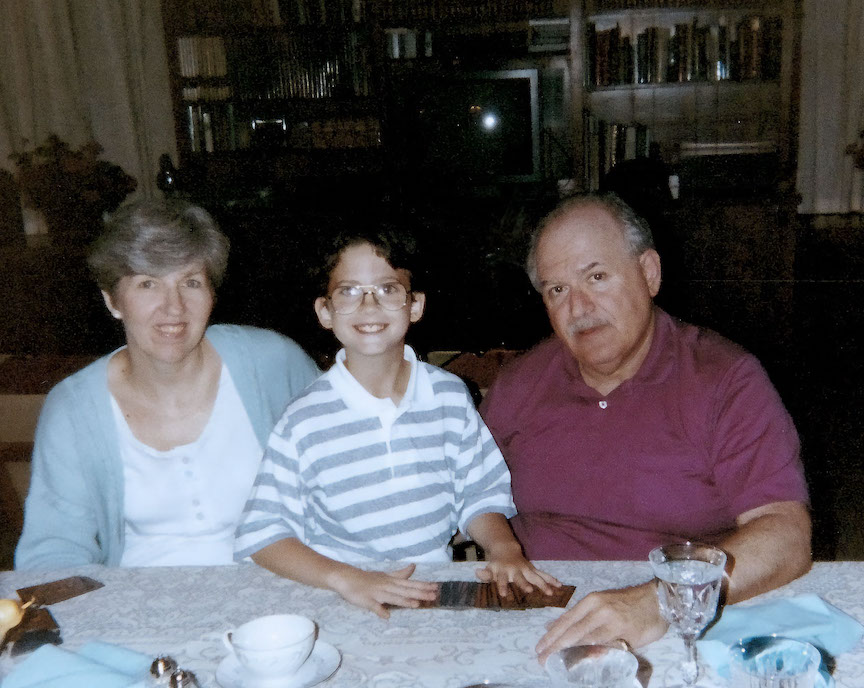
Kathy, my nephew Zack, and Ron in my Mom and Dad's New Orleans home some 35 years ago. photo credit: courtesy Zack Kron
|
|
There was a point, I believe only a few years into my time at NIU, when Mode suddenly fell seriously ill while in his office: he could sit up but could not talk, play trumpet, or swallow. Kathy (his wife or perhaps still fiancée at the time) urgently called me; and I made the rare decision to phone my dad, a neurologist, and seek his long-distance medical advice for my friend. Given my description of the symptoms, my dad immediately identified the very rare but likely cause and suggested Kathy and Ron relay that information to Ron’s doctors, who later confirmed the issue. Dad said Ron would likely completely recover, but only after five or six months would pass. Meantime, it fell to me to run the top Jazz Ensemble, take it on a tour, and finish out the semester with new responsibilities. It was a great learning experience, despite the reason.
Deeply grateful, once better Ron flew me down to New Orleans with Kathy to meet my folks. He and Kathy met most of my family there: my folks adopted Ron, and he adopted them in turn. On our many phone calls over the decades since, he’d ask me about each sibling and their kids.
That only further cemented our friendsship.
A year or so later, I had to have an operation. And since I had no family up here, one of my parents was thinking of flying up. Ron spoke to them and said, “He has family here.” And the first voice I heard in the recovery room here was Ron, on the phone to my parents in New Orleans, telling them I was OK.
I recall playing at their wedding reception (I believe his request was “Come Rain or Come Shine”) and sharing countless musical and personal occasions with them both. Once, when Ron and I co-hosted Tito Puente as a guest artist, Ron asked Tito to call my dad (a fellow Puerto Rican) to chat for a few minutes. That meant a lot to my father.
And when I landed a grant to compose original music for the local community orchestra, I asked Ron if I could write him in as the soloist for a new concerto. And thus my four-movement orchestral work “Crescent City Scenes” was born.
Ron was not an improvising trumpeter (much to the surprise of so many who know of his ability to coach jazz musicians); but he was a brilliant stylist. So I wrote out his solos, ran them by him for approval; and we partnered on a concert on which I conducted the entire program, including his performance of “Nessun Dorma” and “Crescent City Scenes.” My parents came up to DeKalb for the concert, and we all had the grandest of reunions.
I was quite happy in DeKalb. By my fifth year I’d certainly realized that my networking extended nationally and beyond because of the opportunities I’d received and created at NIU. I’d made dear friends, owned a house, and greatly enjoyed my work. But fiscal concerns at NIU had dictated that I consider looking elsewhere, as at the same time as I was receiving university-wide recognition for my teaching excellence, I was documented as one of—if not the—lowest-paid full-time faculty members at VCU. It was largely a fact of salary compression across the school over the years, and I held no one personally responsible.
When I did leave in Fall 1993 to accept a post at Northwestern University, Ron could easily have turned a cold shoulder. He’d made it plain to me and to others over the years that he’d hoped that once he might retire—albeit years into the future—that I might step in to run the Jazz Ensemble.
|
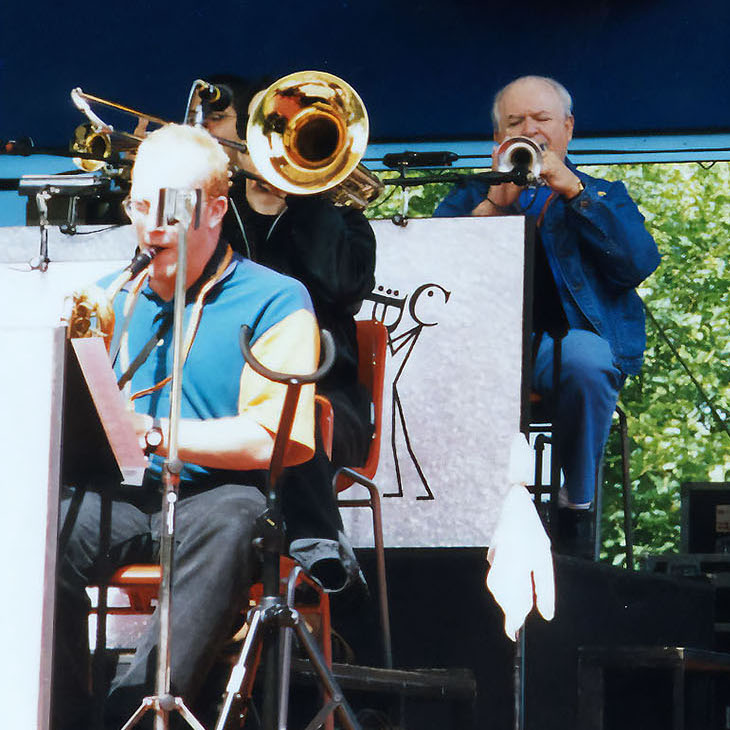
My low-end partner Kevin Sheehan on bari sax, yours truly (behind that massive bass bone bell), and Ron soundchecking in Nice, France. photo credit: courtesy Kevin Sheehan |
But Ron had no cold shoulder. I and my family remained just as close to Ron, and he to us. I interviewed him in 1994 for the August cover feature of The Instrumentalist, an article we titled “For the Love of Jazz.” So when Ron called me in 1997, saying that he knew I loved playing bass trombone in big band more than any other chair—and that it was possible he’d be contracting musicians to create The Phil Collins Big Band for a Summer 1998 tour—and would I like to join him and a number of former students and colleagues on said tour, if it were to happen—I was surprised by the opportunity but not at all surprised that Ron might reach out to me. He was that kind of guy, even though I’d left NIU and changed his future plans.
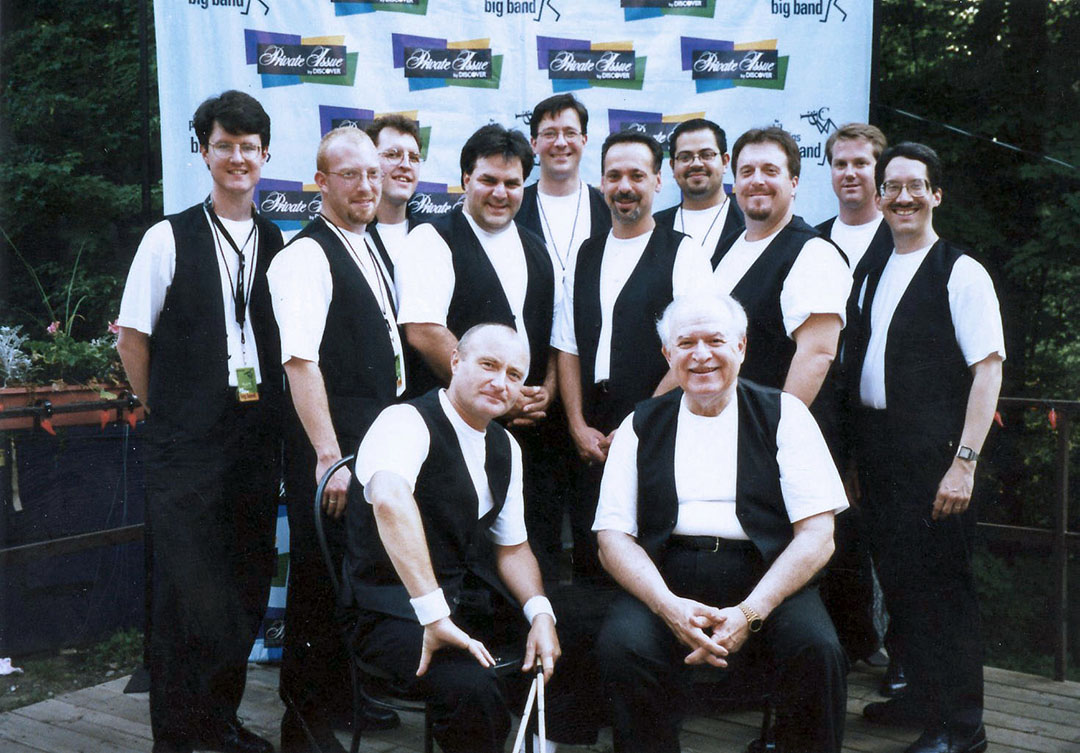
With Phil Collins (front left) and Ron Modell (front right), all the NIU friends and colleagues that Ron had contracted for The Phil Collins Big Band 1998 international tour, including yours truly (standing front row, right). Taken in Detroit, MI. photo credit: unknown. A lot of copies have circulated!
|
|
When the tour eventually materialized, Ron and I and our friends had the most marvelous musical and personal experience, rehearsing in Switzerland for nine days, touring the U.S. for three weeks, and touring Europe for another three weeks. Once again, Ron had curated an experience for his close friends that was unparalleled. And throughout the two months, he sat right behind me at the far edge of the band; so I knew every note he put into that horn.
As hard as we worked on that tour, an incredible plus was the opportunity for us all to share so many conversations for two months. Travelling the world, I had a lot more down-time with Ron and Kathy than I’d had with them in the five years since I’d left NIU; so we became even closer.
|
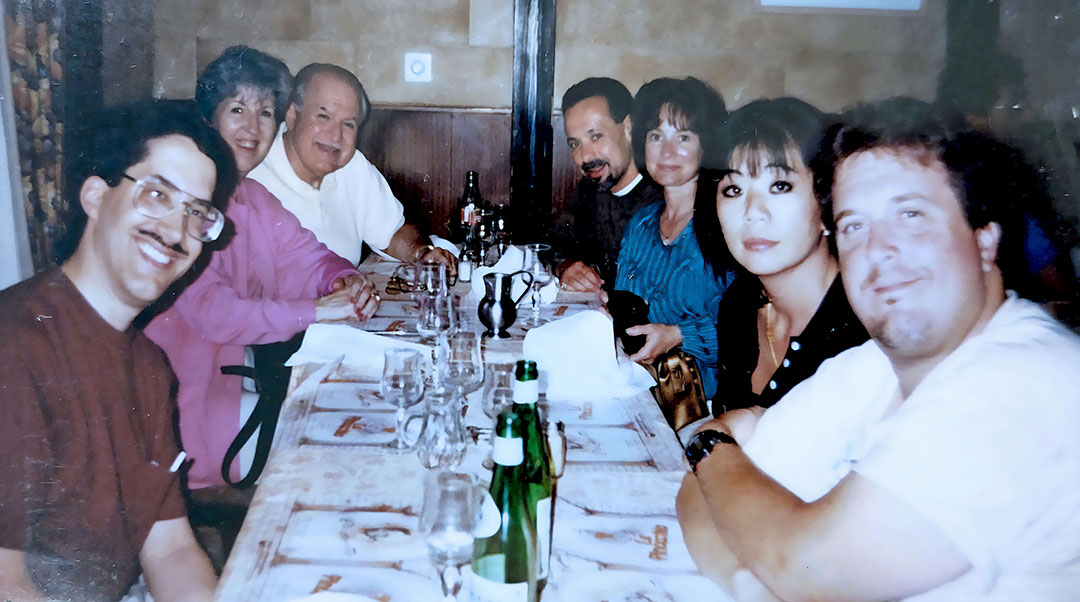
At left, yours
truly, Kathy, and Ron enjoying another wonderful meal on tour, here with |
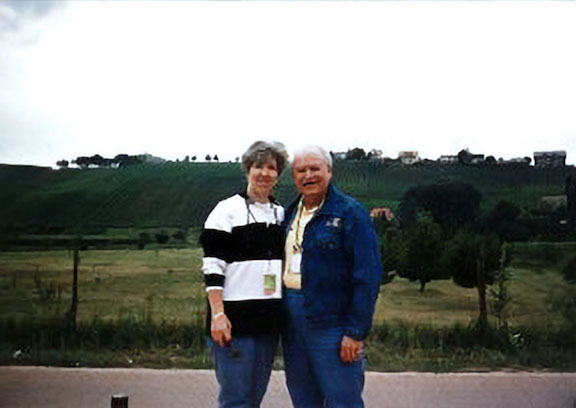
Ron and Kathy enjoying lovely Luxembourg prior to our PCBB concert that evening. photo credit: Antonio García
|
|
In 2014 he published a memoir, Loved Bein’ Here With You. 190 pages of memories and instructional tips!
Anyone who knew Ron knows he was quick to tell a joke. He was a master, and we all told him he could’ve done standup comedy. Then, in his retirement, he did just that, delivering jokes in a comedy club in Florida. True, they may not all have been original jokes; but his delivery was entirely original, hit the mark, and was wildly appreciated by his newfound fans. He made occasional appearances there for many years, his last when he was 90!
Over the past 25 or more years, when we’d talk on the phone, we always turned to catching up on family and former students. Those are who mattered to Ron, and we had a lot in common.
When Ron’s Celebration of Life took place in June, I was in dress rehearsals for a community jazz band (ages 19 to 93!) in Colorado that was a five-day commitment. I had 40 people depending on me that week and so decided I’d see that through rather than leave rehearsals for the Celebration in Illinois and attempt a cross-country return for the concert. I thought Ron would understand. He was deep into community. I recall that for many years he would umpire little league baseball games in DeKalb when he could easily have sat back and taken that time off from his busy life.
As a theater-influenced fundraiser, ensemble director, interpersonal connector, mentor, and mensch, Ron was a dear and deep friend who demonstrated to me first-hand how a lot could be done with jazz in academia—and who demonstrated to all how his love for Kathy could make the world go ’round and ’round in happiness. He was a generous man whose thoughts and actions played an immense role in launching my career and calibrating my professional and personal compass.
My family and I will miss his cheery voice, his insights, and his love; and we send our love and hopes out to Kathy and Ron’s family in his absence.
_ _ _ _ _ _ _ _ _ _ _ _ _ _ _
Antonio J. García is a Professor Emeritus and former Director of Jazz Studies at Virginia Commonwealth University, where he directed the Jazz Orchestra I; instructed Applied Jazz Trombone, Small Jazz Ensemble, Jazz Pedagogy, Music Industry, and various jazz courses; founded a B.A. Music Business Emphasis (for which he initially served as Coordinator); and directed the Greater Richmond High School Jazz Band. An alumnus of the Eastman School of Music and of Loyola University of the South, he has received commissions for jazz, symphonic, chamber, film, and solo works—instrumental and vocal—including grants from Meet The Composer, The Commission Project, The Thelonious Monk Institute, and regional arts councils. His music has aired internationally and has been performed by such artists as Sheila Jordan, Arturo Sandoval, Jim Pugh, Denis DiBlasio, James Moody, and Nick Brignola. Composition/arrangement honors include IAJE (jazz band), ASCAP (orchestral), and Billboard Magazine (pop songwriting). His works have been published by Kjos Music, Hal Leonard, Kendor Music, Doug Beach Music, ejazzlines, Walrus, UNC Jazz Press, Three-Two Music Publications, Potenza Music, and his own garciamusic.com, with five recorded on CDs by Rob Parton’s JazzTech Big Band (Sea Breeze and ROPA JAZZ). His scores for independent films have screened across the U.S. and in Italy, Macedonia, Uganda, Australia, Colombia, India, Germany, Brazil, Hong Kong, Mexico, Israel, Taiwan, and the United Kingdom. One of his recent commissions was performed at Carnegie Hall by the Orpheus Chamber Orchestra.
A Conn-Selmer trombone clinician, Mr. García serves as the jazz clinician for The Conn-Selmer Institute. He has freelanced as trombonist, bass trombonist, or pianist with over 70 nationally renowned artists, including Ella Fitzgerald, George Shearing, Mel Tormé, Doc Severinsen, Louie Bellson, Dave Brubeck, and Phil Collins—and has performed at the Montreux, Nice, North Sea, Pori (Finland), New Orleans, and Chicago Jazz Festivals. He has produced recordings or broadcasts of such artists as Wynton Marsalis, Jim Pugh, Dave Taylor, Susannah McCorkle, Sir Roland Hanna, and the JazzTech Big Band and is the bass trombonist on Phil Collins’ CD “A Hot Night in Paris” (Atlantic) and DVD “Phil Collins: Finally...The First Farewell Tour” (Warner Music). An avid scat-singer, he has performed vocally with jazz bands, jazz choirs, and computer-generated sounds. He is also a member of the National Academy of Recording Arts & Sciences (NARAS). A New Orleans native, he also performed there with such local artists as Pete Fountain, Ronnie Kole, Irma Thomas, and Al Hirt.
Most of all, Tony is dedicated to assisting musicians towards finding their joy. His 35-year full-time teaching career and countless residencies in schools have touched tens of thousands of students in Canada, Europe, South Africa, Australia, The Middle East, and across the U.S. His collaborations highlighting jazz and social justice have raised hundreds of thousands of dollars, providing education to students and financial support to African American, Latinx, LGBTQ+, and Veterans communities, children’s medical aid, and women in jazz. He serves as a Research Faculty Member at the University of KwaZulu-Natal. His partnerships with South Africa focusing on racism and healing resulted in his performing at the Nelson Mandela National Memorial Service in D.C. in 2013. He also fundraised $5.5 million in external gift pledges for the VCU Jazz Program.
Mr. García is the Past Associate Jazz Editor of the International Trombone Association Journal. He has served as a Network Expert (for Improvisation Materials), President’s Advisory Council member, and Editorial Advisory Board member for the Jazz Education Network . His newest book, Jazz Improvisation: Practical Approaches to Grading (Meredith Music), explores avenues for creating structures that correspond to course objectives. His book Cutting the Changes: Jazz Improvisation via Key Centers (Kjos Music) offers musicians of all ages the opportunity to improvise over standard tunes using just their major scales. He is Co-Editor and Contributing Author of Teaching Jazz: A Course of Study (published by NAfME), authored a chapter within Rehearsing The Jazz Band and The Jazzer’s Cookbook (published by Meredith Music), and contributed to Peter Erskine and Dave Black’s The Musician's Lifeline (Alfred). Within the International Association for Jazz Education he served as Editor of the Jazz Education Journal, President of IAJE-IL, International Co-Chair for Curriculum and for Vocal/Instrumental Integration, and Chicago Host Coordinator for the 1997 Conference. He served on the Illinois Coalition for Music Education coordinating committee, worked with the Illinois and Chicago Public Schools to develop standards for multi-cultural music education, and received a curricular grant from the Council for Basic Education. He has also served as Director of IMEA’s All-State Jazz Choir and Combo and of similar ensembles outside of Illinois. He is the only individual to have directed all three genres of Illinois All-State jazz ensembles—combo, vocal jazz choir, and big band (plus All-County and community concert bands and orchestras). He is the recipient of the Illinois Music Educators Association’s 2001 Distinguished Service Award.
Regarding Jazz Improvisation: Practical Approaches to Grading, Darius Brubeck says, "How one grades turns out to be a contentious philosophical problem with a surprisingly wide spectrum of responses. García has produced a lucidly written, probing, analytical, and ultimately practical resource for professional jazz educators, replete with valuable ideas, advice, and copious references." Jamey Aebersold offers, "This book should be mandatory reading for all graduating music ed students." Janis Stockhouse states, "Groundbreaking. The comprehensive amount of material García has gathered from leaders in jazz education is impressive in itself. Plus, the veteran educator then presents his own synthesis of the material into a method of teaching and evaluating jazz improvisation that is fresh, practical, and inspiring!" And Dr. Ron McCurdy suggests, "This method will aid in the quality of teaching and learning of jazz improvisation worldwide."
About Cutting the Changes, saxophonist David Liebman states, “This book is perfect for the beginning to intermediate improviser who may be daunted by the multitude of chord changes found in most standard material. Here is a path through the technical chord-change jungle.” Says vocalist Sunny Wilkinson, “The concept is simple, the explanation detailed, the rewards immediate. It’s very singer-friendly.” Adds jazz-education legend Jamey Aebersold, “Tony’s wealth of jazz knowledge allows you to understand and apply his concepts without having to know a lot of theory and harmony. Cutting the Changes allows music educators to present jazz improvisation to many students who would normally be scared of trying.”
Of his jazz curricular work, Standard of Excellence states: “Antonio García has developed a series of Scope and Sequence of Instruction charts to provide a structure that will ensure academic integrity in jazz education.” Wynton Marsalis emphasizes: “Eight key categories meet the challenge of teaching what is historically an oral and aural tradition. All are important ingredients in the recipe.” The Chicago Tribune has highlighted García’s “splendid solos...virtuosity and musicianship...ingenious scoring...shrewd arrangements...exotic orchestral colors, witty riffs, and gloriously uninhibited splashes of dissonance...translucent textures and elegant voicing” and cited him as “a nationally noted jazz artist/educator...one of the most prominent young music educators in the country.” Down Beat has recognized his “knowing solo work on trombone” and “first-class writing of special interest.” The Jazz Report has written about the “talented trombonist,” and Cadence noted his “hauntingly lovely” composing as well as CD production “recommended without any qualifications whatsoever.” Phil Collins has said simply, “He can be in my band whenever he wants.” García is also the subject of an extensive interview within Bonanza: Insights and Wisdom from Professional Jazz Trombonists (Advance Music), profiled along with such artists as Bill Watrous, Mike Davis, Bill Reichenbach, Wayne Andre, John Fedchock, Conrad Herwig, Steve Turre, Jim Pugh, and Ed Neumeister.
Tony is the Secretary of the Board of The Midwest Clinic and a past Advisory Board member of the Brubeck Institute. The partnership he created between VCU Jazz and the Centre for Jazz and Popular Music at the University of KwaZulu-Natal merited the 2013 VCU Community Engagement Award for Research. He has served as adjudicator for the International Trombone Association’s Frank Rosolino, Carl Fontana, and Rath Jazz Trombone Scholarship competitions and the Kai Winding Jazz Trombone Ensemble competition and has been asked to serve on Arts Midwest’s “Midwest Jazz Masters” panel and the Virginia Commission for the Arts “Artist Fellowship in Music Composition” panel. He was published within the inaugural edition of Jazz Education in Research and Practice and has been repeatedly published in Down Beat; JAZZed; Jazz Improv; Music, Inc.; The International Musician; The Instrumentalist; and the journals of NAfME, IAJE, ITA, American Orff-Schulwerk Association, Percussive Arts Society, Arts Midwest, Illinois Music Educators Association, and Illinois Association of School Boards. Previous to VCU, he served as Associate Professor and Coordinator of Combos at Northwestern University, where he taught jazz and integrated arts, was Jazz Coordinator for the National High School Music Institute, and for four years directed the Vocal Jazz Ensemble. Formerly the Coordinator of Jazz Studies at Northern Illinois University, he was selected by students and faculty there as the recipient of a 1992 “Excellence in Undergraduate Teaching” award and nominated as its candidate for 1992 CASE “U.S. Professor of the Year” (one of 434 nationwide). He is recipient of the VCU School of the Arts’ 2015 Faculty Award of Excellence for his teaching, research, and service, in 2021 was inducted into the Conn-Selmer Institute Hall of Fame, and is a 2023 recipient of The Midwest Clinic's Medal of Honor. Visit his web site at <www.garciamusic.com>.
If you entered this page via a search
engine and would like to visit more of this site,